

Latest Version
Visit PageMore About :game
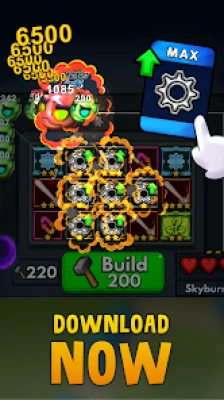
The game combines classic tower defense with unpredictable merge mechanics. You need to think about tower placement, deck composition, upgrades and timing while dealing with enemies such as balloons and zombies. Bosses introduce additional threats, while PvP, co-op and Draft modes provide competitive and multiplayer challenges.
Merge Clash: Tower Defense TD Overview
Merge Clash is not a traditional tower defense game where every unit behaves exactly as expected.
Its central mechanic is the merge system. Matching towers can be combined to create a stronger tower, but the result can also change tower type. That element of randomness means a successful strategy needs both planning and flexibility.
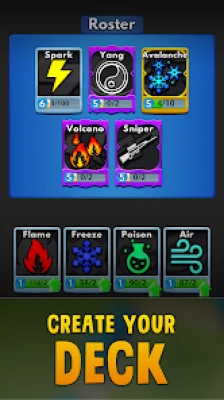
You begin by creating a deck of five towers. During battles, you deploy towers, merge them when appropriate and build a defense capable of surviving enemy waves.
The more effectively you manage your towers and resources, the longer your defense can survive.
Game Information
Game: Merge Clash: Tower Defense TD
Developer: Puzzle Cats
Genre: Strategy / Tower Defense
Platforms: Android and Windows
Main gameplay: Tower defense and merging
Tower deck: Five towers
Tower collection: 50+ towers
Enemies: Balloons, zombies and other threats
Modes: Solo defense, PvP, co-op and Draft
Progression: Tower collection and upgrades
Monetization: Ads and in-app purchases
Current Google Play rating: 4.5 stars
Current Google Play downloads: 500K+
Latest listed update: September 3, 2026
What Is Merge Clash: Tower Defense TD?
Merge Clash is a tower defense strategy game where your goal is to protect your base from waves of enemies.
Instead of simply placing towers and leaving them untouched, you continuously make decisions about which towers to deploy, which ones to merge and which abilities are most useful for the current wave.
The five-tower deck system adds another strategic layer. You cannot bring everything into a battle, so choosing a balanced collection of towers is important.
The random nature of merging makes every battle slightly different. A merge can improve your position, but it can also produce a tower that does not fit your immediate plan.
Main Features
Five-Tower Deck Building
Every battle revolves around your selected five-tower deck.
This means you need to think about your deck before entering a difficult battle. A deck with only one type of offensive capability can struggle when enemies become more difficult.
A balanced selection gives you more options when the battlefield becomes chaotic.
50+ Towers to Collect
The game features more than 50 towers with different abilities and characteristics. Collecting and upgrading them gives you the opportunity to experiment with different defensive combinations.
Merge Mechanics
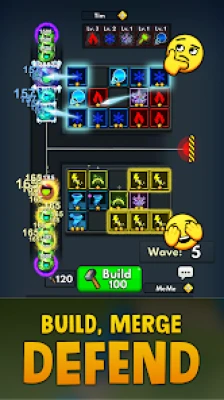
Matching towers can be merged to increase their level and damage.
However, the result can be random and may change the tower type. This makes merging a tactical decision rather than an automatic action.
Wave-Based Defense
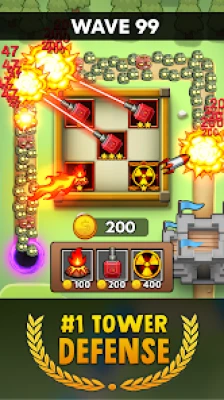
Enemies arrive in waves, creating progressively greater pressure on your defenses.
Your objective is to survive while building enough offensive power to eliminate enemies before they overwhelm your base.
Boss Battles
Bosses introduce special abilities that can disrupt an otherwise successful defense.
You need to recognize the boss threat and adjust your strategy instead of relying on the same setup throughout the battle.
PvP Tower Defense
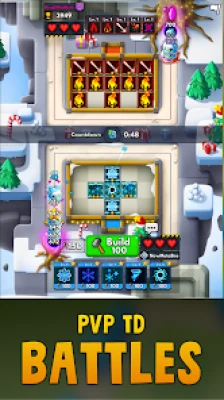
Merge Clash includes competitive PvP tower defense battles.
PvP requires a different mindset because you are not simply trying to survive a predictable enemy sequence. You also need to build a deck and play in a way that can withstand another player's strategy.
Co-op Tower Defense
You can team up with friends in co-op tower defense.
Working with another player changes how you should think about tower roles. Instead of both players trying to do everything, coordinated defenses can cover different weaknesses.
Draft Mode
The Draft mode allows players to experiment with towers and compete using selections that may differ from their usual deck.
This can be particularly useful for learning towers you would not normally use.
How to Play Merge Clash
The basic battle loop is:
Build a deck of five towers.
Enter a tower defense battle.
Deploy towers to defend your base.
Watch the enemy wave.
Merge matching towers when the situation calls for it.
Upgrade your defensive power.
Adapt when a merge changes your tower.
Survive increasingly difficult waves.
Defeat bosses when they appear.
Improve your tower collection and deck for future battles.
The controls are simple, but the decisions become increasingly strategic.
Complete Merge Clash Strategy Guide
1. Build a Balanced Five-Tower Deck
Do not choose five towers simply because they have high damage.
Your deck should ideally give you different ways to handle enemies.
Consider having:
Reliable damage
Stronger damage for tougher enemies
A tower useful against groups
A tower that provides a different tactical function
A flexible option for difficult situations
The exact combination can change as your tower collection develops.
The important principle is balance.
2. Do Not Merge Automatically
The merge button can be tempting, but merging every possible pair is not always the correct decision.
Before merging, ask:
Will this merge improve my current defense?
If two towers are already covering important areas, removing one could create a weakness.
A merge should solve a problem rather than simply make a tower stronger.
3. Watch Your Battlefield Before Merging
Always look at what is happening around your towers.
If a dangerous enemy wave is approaching, preserving a useful tower may be more important than chasing a higher-level merge.
If your defense is stable, you may have more freedom to experiment.
This is one of the biggest differences between beginner and experienced play.
4. Use the Random Merge System to Your Advantage
The random outcome is one of the defining features of Merge Clash.
You cannot always control what a merge produces, so your strategy should not depend on getting one specific result every time.
Instead, create flexible board positions.
If the merge gives you a different tower type, immediately ask:
Where can it contribute?
Does it replace another tower?
Should another tower be merged?
Has my defensive priority changed?
The ability to recover from an unexpected merge is a major part of mastering the game.
5. Protect Your Strongest Defensive Position
Do not spread your attention evenly across every tower.
Identify which towers are currently doing the most important work and protect that defensive structure.
If one area is handling most of the enemy pressure, avoid accidentally weakening it through unnecessary merges.
6. Prioritize Threats
Not every enemy deserves the same attention.
When multiple enemy types appear, focus on the threats most likely to break your defense.
A weaker enemy that reaches your base is less dangerous than a tougher enemy capable of surviving long enough to overwhelm your key defensive area.
Learn which enemies your current deck struggles against and prepare accordingly.
7. Upgrade With a Purpose
Tower upgrades should support your overall strategy.
Do not automatically spend resources on every available upgrade.
Ask which upgrade will have the greatest effect on your next battles.
If your main weakness is damage against strong enemies, prioritize improvements that address that weakness.
If your problem is getting overwhelmed by groups, prioritize the tools that improve your ability to handle multiple targets.
8. Learn From Every Failed Defense
A loss is useful when you understand why it happened.
After losing, consider:
Did the deck lack damage?
Did you merge too aggressively?
Was your tower selection too specialized?
Did a boss counter your setup?
Did you fail to respond to the enemy wave?
Did you upgrade the wrong towers?
Change one or two things and test again.
Avoid completely rebuilding your strategy after every loss.
Boss Battle Strategy
Bosses are designed to punish predictable defenses.
The game specifically gives bosses special abilities, so you should expect your normal strategy to require adjustment.
Before the Boss
Try to enter a boss encounter with a stable defensive formation.
Avoid unnecessary merges immediately before a major threat arrives unless the merge clearly strengthens your position.
During the Boss
Watch the boss rather than focusing only on your towers.
Identify what its special ability does and determine which part of your defense is most vulnerable.
Then make controlled changes.
After the Boss
If the boss exposes a weakness in your deck, remember it.
A difficult boss can tell you more about your deck than several easy waves.
PvP Strategy Guide
PvP requires more flexibility than basic wave defense.
A strategy that works against computer-controlled waves may not work as well against another player.
Build for Consistency
Do not create a deck that depends on getting one perfect merge.
Randomness is part of the game, so your deck should remain useful even when your preferred outcome does not happen.
Avoid Panic Merging
In competitive battles, rushing merges because the opponent is progressing can make your own board weaker.
Keep your defense stable first.
Adapt to Pressure
If your opponent is putting you under pressure, identify the actual weakness rather than simply increasing tower levels wherever possible.
The right response may be a different merge, a different tower position or a different deck choice in the next match.
Co-op Strategy Guide
Co-op is about coordination.
If both players build nearly identical defenses, you may waste opportunities to cover weaknesses.
Instead, communicate around roles.
One player can concentrate on consistent damage while the other provides a different type of coverage.
The best co-op strategy depends on the towers available to both players, so flexibility is more important than following one fixed combination.
Draft Mode Strategy
Draft is a useful opportunity to experiment.
You may receive towers that are not part of your normal deck, so avoid judging them only by whether they fit your preferred playstyle.
Use Draft to learn:
Which towers complement each other
Which towers are difficult to use
Which abilities are useful in specific situations
Which combinations can handle different enemy pressures
The experience can improve your regular deck-building decisions.
Resource Management Tips
Do Not Waste Upgrade Opportunities
Focus your resources on towers that actually contribute to your preferred strategy.
Think Long Term
A tower that is useful now may not remain central to your deck later.
Avoid putting all your resources into a single strategy without testing alternatives.
Use Progression to Experiment
As you obtain new towers, try them in controlled situations.
You may discover that a tower you initially ignored fills a weakness in your existing deck.
Best Beginner Strategy
If you are new to Merge Clash, keep your approach simple.
Step 1: Learn Your Towers
Understand what each tower in your deck actually does.
Step 2: Build a Balanced Deck
Avoid filling all five slots with towers that perform the same function.
Step 3: Merge Carefully
Do not merge simply because two matching towers are available.
Step 4: Watch Enemy Waves
Look for the point where your defense starts struggling.
Step 5: Identify Your Weakness
If enemies are reaching your base, determine why.
Step 6: Adjust
Change your deck or merging decisions based on what you learned.
Advanced Merge Strategy
Experienced players should think several steps ahead.
Suppose you have two matching towers that can be merged.
There are two questions:
Question one: Will the immediate upgrade improve my damage?
Question two: What happens to my board if the random result changes the tower type?
If the second answer creates a major weakness, waiting may be better.
This makes Merge Clash different from simple merge games. The value of a merge depends on both the immediate result and the defensive position it creates.
Common Mistakes
Merging Whenever Possible
More merges do not automatically mean a better defense.
Building an Unbalanced Deck
Five powerful towers can still make a weak deck if they do not cover different situations.
Ignoring Boss Abilities
Bosses can disrupt predictable defenses.
Spending Resources Everywhere
Upgrade priorities matter.
Copying One Strategy Forever
A deck that works early may struggle against later enemies or different opponents.
Panicking in PvP
Fast decisions are useful, but rushed decisions can make your board weaker.
Ignoring Tower Diversity
Experiment with different towers instead of depending entirely on a small group.
How to Improve Quickly
The fastest way to improve is to understand why your defense succeeds or fails.
After each battle, identify one specific lesson.
For example:
“I needed stronger group damage.”
“I merged too early.”
“My deck could not handle the boss.”
“I relied too much on one tower.”
“My defense collapsed because I ignored one side.”
Then make a small adjustment.
This creates a much more reliable improvement cycle than simply playing more matches without analyzing them.
Tips for Long-Term Progress
Build several viable tower combinations.
Keep experimenting with new towers.
Do not depend on one perfect merge.
Upgrade towers that solve real weaknesses.
Learn boss mechanics.
Practice PvP separately from normal defense.
Use Draft to discover new combinations.
Coordinate roles during co-op.
Avoid unnecessary merges.
Review your losses instead of simply repeating them.
Ads and In-App Purchases
The current Google Play listing includes ads and in-app purchases, including purchases that can contain random items.
Players should therefore treat purchases as optional progression rather than something required to understand the game's core mechanics.
If you enjoy the game without spending money, focusing on deck building, merging decisions and gradual tower upgrades can provide a more strategic experience.
Player Feedback
Current Google Play reviews are generally positive, but some players have raised concerns about tower diversity, timed chests, content variety and occasional bugs. These are individual player opinions rather than universal problems, but they are useful considerations when evaluating the game.
The strongest appeal remains the combination of tower defense, random merging and competitive modes.
Pros and Cons
Pros
Easy-to-understand tower defense concept
Strategic five-tower deck building
50+ towers to collect
Random merge mechanics
Tower upgrades
Boss battles
PvP battles
Co-op gameplay
Draft mode
Regular updates and improvements
Available on Android and Windows
Cons
Random merges can sometimes work against your plan
Some progression systems may feel slow
Timed rewards can frustrate some players
Advertising is part of the free-to-play experience
Players may want greater tower and mode variety
Competitive results can be affected by randomness
Is Merge Clash: Tower Defense TD Worth Playing?
Yes, especially if you enjoy tower defense games that add an element of unpredictability.
The strongest part of Merge Clash is the way merging changes traditional tower defense. You are not simply choosing where to place a tower and waiting for enemies to disappear. You constantly have to decide whether merging will improve your position or create a new problem.
The PvP, co-op and Draft modes also provide more variety than a simple single-player tower defense game.
However, players who dislike random mechanics or free-to-play progression systems may find some aspects frustrating.
Who Should Play Merge Clash?
Merge Clash is a good choice for players who enjoy:
Tower defense games
Merge mechanics
Strategy games
Deck building
Competitive mobile games
PvP challenges
Co-op gameplay
Boss battles
Collection and upgrade systems
Short strategic matches
Merge Clash Tips at a Glance
Build a balanced five-tower deck.
Do not merge automatically.
Consider the possible consequences of every merge.
Protect your strongest defensive positions.
Upgrade towers that solve your biggest weaknesses.
Study boss abilities.
Do not rely on one perfect tower combination.
Use Draft mode to experiment.
Coordinate tower roles in co-op.
Stay calm during PvP.
Learn from failed defenses.
Experiment with new towers as your collection grows.
Frequently Asked Questions
What is Merge Clash: Tower Defense TD?
Merge Clash: Tower Defense TD is a mobile strategy game combining tower defense, tower merging, deck building and competitive multiplayer.
How many towers can you use in a deck?
The game allows you to build a deck of five towers.
How does merging work?
Matching towers can be merged to increase their level and damage, but the resulting tower type can change randomly.
How many towers are available?
The current game description advertises more than 50 towers to collect and upgrade.
Does Merge Clash have PvP?
Yes. Merge Clash includes competitive PvP tower defense battles.
Can you play Merge Clash with friends?
Yes. The game includes co-op tower defense where players can team up to defend the kingdom.
Are there boss battles?
Yes. Bosses have special abilities that require players to adjust their defense strategy.
What is Draft mode?
Draft allows players to try different towers and compete using selections outside their usual deck.
What is the best Merge Clash strategy?
There is no single best deck for every situation. A balanced five-tower deck, careful merging, smart upgrades and the ability to adapt to random tower results are more important than following one fixed combination.
Is Merge Clash suitable for beginners?
Yes. The basic tower defense mechanics are easy to understand, while the random merging and deck-building systems provide additional depth as you progress.
Final Verdict
Merge Clash: Tower Defense TD combines familiar tower defense gameplay with a risky and unpredictable merging system.
The five-tower deck forces you to make meaningful choices before battle, while random merges prevent every match from following exactly the same pattern. Bosses add additional pressure, and PvP, co-op and Draft modes give the game more variety.
The key to success is not simply creating the strongest towers possible. You need to maintain a stable defense, merge intelligently, understand your deck's weaknesses and adapt when the random system produces an unexpected result.
For fans of mobile tower defense, merge strategy and competitive battles, Merge Clash is a game worth trying.
Rate the Game
User Reviews












Popular Games



















 Android
 iOS
 Windows
 Xbox