

Latest Version
August 12, 2026
Oakever Games
Puzzle
iOS
0
Report a Problem
More About :game
Meowdoku! takes familiar logic-puzzle concepts and gives them a completely different presentation.
Instead of numbers, you work with cute cats.
Instead of simply filling rows and columns, you must determine the correct territory for every cat.
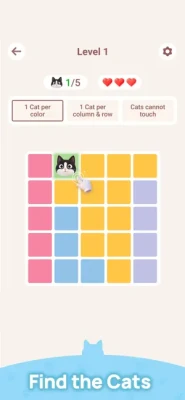
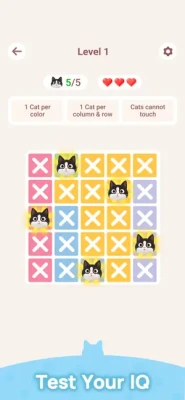
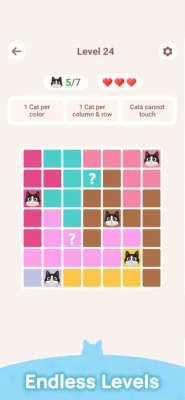
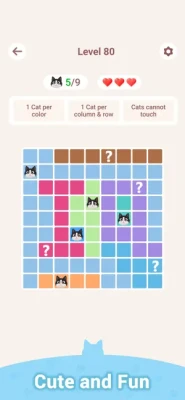
The board is divided into colored sections. Your objective is to place exactly one cat in each section while respecting the game's placement rules.
That means every move has to be considered carefully.
A placement that looks correct at first may make another part of the board impossible to solve.
How to Play Meowdoku!
The basic rules are straightforward:
- Examine the colored sections.
- Determine where each cat can legally go.
- Place one cat in each section.
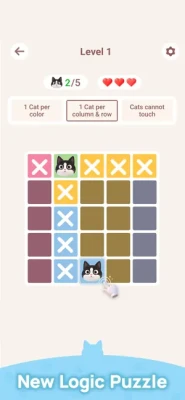
- Make sure no two cats share a row.
- Make sure no two cats share a column.
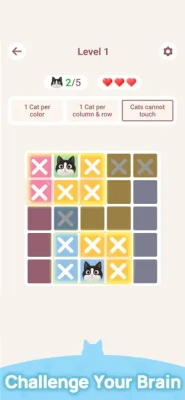
- Make sure cats do not touch, even diagonally.
- Complete the entire board without exhausting your mistakes.
The App Store describes the game as combining Sudoku-style reasoning with Minesweeper-style deduction.
The Exclusive Territory Rule
Every colored territory must contain exactly one cat.
This is the foundation of every puzzle.
You can't simply place cats wherever they appear to fit.
You have to consider the territory boundaries as well as the row, column, and neighboring-cell restrictions.
This creates a layered logic problem where one correct placement can help determine several other positions.
The Aloof Cat Rule
The cats in Meowdoku! apparently prefer their personal space.
Two cats cannot:
- Share the same row
- Share the same column
- Touch horizontally
- Touch vertically
- Touch diagonally
The diagonal restriction is particularly important because it eliminates positions that might otherwise look valid.
This rule is one of the main differences between Meowdoku! and conventional Sudoku.
Sudoku Meets Minesweeper
Meowdoku! isn't simply a cat-themed Sudoku clone.
Its puzzle structure borrows the logical thinking associated with both Sudoku and Minesweeper.
Sudoku encourages players to eliminate impossible positions based on rows and columns.
Minesweeper encourages deduction based on surrounding information.
Meowdoku! combines those ideas into a territory-based cat placement puzzle.
The result is a game that can be learned quickly but becomes increasingly demanding as the puzzles become more complicated.
Three Chances to Make a Mistake
The current game gives players three hearts, meaning mistakes are limited.
A wrong placement costs a heart, so guessing repeatedly isn't an effective strategy.
This encourages logical deduction.
Before placing a cat, ask:
Why must this cat go here?
rather than:
Could this cat go here?
That distinction becomes increasingly important on harder boards.
Daily Puzzles
Meowdoku! includes Daily Puzzles, giving players a fresh reason to return each day.
Daily challenges work particularly well with this type of game because a single puzzle can provide a short mental workout without requiring a long gaming session.
You can play one puzzle during a coffee break or continue solving boards for a longer session.
Global Leaderboards
The game also includes global leaderboards where players can compare their completion times.
This adds a competitive element without changing the fundamental single-player puzzle experience.
For players who enjoy optimization, completing a puzzle isn't necessarily the final goal.
You can also try to solve it faster.
Puzzle Difficulty
Meowdoku! starts with an approachable concept.
The rules can be understood within minutes, but applying them efficiently requires increasingly sophisticated deduction.
Beginner
Early puzzles help you understand:
- Territory placement
- Row restrictions
- Column restrictions
- Neighbor restrictions
Intermediate
More complicated territory arrangements require you to combine multiple clues.
Advanced
Harder boards require several steps of deduction and careful planning because one incorrect placement can affect numerous possible positions.
Beginner's Guide
1. Start With the Most Restricted Territory
Look for a colored section containing very few possible cat positions.
These areas often provide the strongest clues.
2. Check Rows and Columns
Before placing a cat, eliminate every cell already affected by another cat.
3. Remember Diagonal Restrictions
Don't forget that cats cannot touch diagonally.
This eliminates more positions than many new players initially expect.
4. Avoid Guessing
You only have three hearts.
Use deduction instead of trial and error whenever possible.
5. Look for Forced Moves
Sometimes only one position can satisfy all of the game's rules.
Those are the moves you should prioritize.
6. Recheck the Whole Board
After placing a cat, look at the remaining territories again.
One placement can reveal new forced positions.
Advanced Meowdoku! Strategies
Use Elimination Chains
If placing a cat in one location removes several possibilities elsewhere, follow those consequences through the board.
Find Unique Candidates
A territory might have several potential cells, but a particular row or column restriction may eliminate all but one.
Work From the Most Constrained Area
Don't necessarily solve the board from top to bottom.
Start where the available options are most limited.
Think Several Moves Ahead
Before making a placement, consider how it changes the possibilities for neighboring territories.
Protect Your Hearts
Three mistakes may disappear quickly if you make guesses without sufficient evidence.
Treat each placement as a logical conclusion rather than an experiment.
Relaxing Puzzle Gameplay
Although Meowdoku! can become challenging, its presentation is deliberately calm.
The cute cat theme, minimalist board design, and simple interaction help create a more relaxed atmosphere than many traditional brain-training games.
This combination is one reason the game can work equally well for short breaks and longer puzzle sessions.
Minimalist Presentation
Meowdoku! doesn't need elaborate graphics to communicate its gameplay.
The board itself is the focus.
Colored territories establish the structure, while cats provide the central visual identity.
The App Store emphasizes the game's minimalist aesthetic and tactile feedback.
Controls and Interface
The controls are intentionally simple.
The current App Store description explains that players can double-tap a tile to place a cat.
There are no complicated combinations or lengthy control schemes.
The challenge comes almost entirely from reasoning.
Offline Play
Meowdoku! supports offline play, according to the current App Store description.
This makes it particularly convenient for:
- Flights
- Commuting
- Waiting rooms
- Travel
- Coffee breaks
- Areas with poor connectivity
Daily and leaderboard features may naturally depend on connectivity, but the core puzzle experience is designed to work without an internet connection.
Is Meowdoku! a Sudoku Game?
Meowdoku! is best described as a Sudoku-inspired logic puzzle, rather than a conventional Sudoku game.
There are no traditional numbers filling a standard Sudoku grid.
Instead, players place cats into territories while following row, column, and adjacency restrictions.
Its logic system shares similarities with Sudoku, but the puzzle structure is distinctly different.
Is Meowdoku! Like Minesweeper?
Yes, in terms of logical deduction.
The game borrows the feeling of eliminating possibilities and determining safe positions, although it doesn't reproduce traditional Minesweeper gameplay.
The developer's App Store description explicitly positions Meowdoku! as a combination of Sudoku reasoning and Minesweeper-style deduction.
Game Progression
The game is designed around repeated puzzle solving rather than traditional character progression.
There are no RPG levels, weapons, or character upgrades at the heart of the experience.
Instead, progression comes from:
- Completing puzzles
- Solving increasingly difficult boards
- Improving completion times
- Playing daily challenges
- Climbing leaderboards
- Improving your logical deduction skills
Replay Value
Logic games naturally have strong replay value because players can continue attempting new puzzles even after mastering the basic rules.
Meowdoku! adds additional reasons to return through daily puzzles and time-based leaderboard competition.
Player Reception
The current U.S. App Store page shows a 4.8/5 rating from approximately 139,000 ratings, demonstrating strong overall player reception.
Positive reviews frequently praise the combination of cute cats, relaxing presentation, and genuinely challenging puzzles.
However, recent reviews also raise concerns about advertising frequency and changes to features such as undo and draft functionality. The developer has responded that some of these features are being tested or adjusted based on player feedback.
This is worth mentioning because the underlying puzzle design receives strong praise, while the surrounding free-to-play experience has generated more mixed opinions.
Advertising and Free-to-Play Experience
Meowdoku! is listed as a free game.
The App Store description promotes non-intrusive ads, but recent user reviews have reported frustration with advertising frequency and certain ad formats.
For a balanced game-page description, it is better to acknowledge both sides rather than presenting the advertising experience as universally interruption-free.
Pros and Cons
Pros
- Original cat-themed logic concept
- Combines Sudoku and Minesweeper-style reasoning
- Easy to learn
- Challenging to master
- Three-heart mistake system encourages careful play
- Daily puzzles
- Global leaderboards
- Offline gameplay
- Minimalist presentation
- Quick sessions
- Strong player rating
- Available on iPhone and iPad
Cons
- Mistakes can become costly on harder puzzles
- Advertising has received criticism from some players
- Some users have reported changes to previously available features
- Repetition can become noticeable for long-term players according to some reviews
- Large file size for a minimalist puzzle game
Who Should Play Meowdoku!?
Meowdoku! is a strong choice for players who enjoy:
- Sudoku
- Minesweeper
- Logic puzzles
- Brain-training games
- Cat games
- Number-free Sudoku alternatives
- Deduction puzzles
- Daily puzzle challenges
- Casual games
- Offline games
- Relaxing mobile games
Who Might Not Enjoy It?
It may not be ideal for players looking for:
- Action gameplay
- RPG progression
- Multiplayer battles
- Fast reflex challenges
- Story-heavy games
- Traditional Sudoku specifically
- Complex graphics
- Competitive multiplayer
Technical Details
Game: Meowdoku!
Subtitle: Brain Puzzle Games
Developer: Oakever Games
Genre: Casual / Puzzle
Platforms: iPhone and iPad
Price: Free
Age Rating: 13+ on the current U.S. App Store
Current Version: 1.10.1
Latest Listed Update: July 23, 2026
Required OS: iOS 15.0 or later
File Size: Approximately 323.6 MB on the current U.S. App Store
Languages: English plus 61 additional languages
Updates and What's New
The latest listed version is 1.10.1, updated July 23, 2026. The current release notes focus on bug fixes and performance improvements.
The game launched worldwide on May 19, 2026 and has received several updates since release.
Meowdoku! vs Traditional Sudoku
| Feature | Meowdoku! | Traditional Sudoku |
|---|---|---|
| Main pieces | Cats | Numbers |
| Board logic | Territories + rows + columns + adjacency | Rows + columns + boxes |
| Diagonal touching | Not allowed | Usually irrelevant |
| Theme | Cats | Number-based |
| Daily puzzles | Yes | Depends on game |
| Time competition | Global leaderboard | Depends on game |
| Guessing | Discouraged | Discouraged |
| Offline play | Yes | Depends on app |
The biggest difference is that Meowdoku! transforms the familiar logic of Sudoku into a visual territory-placement puzzle.
Meowdoku! vs Minesweeper
Minesweeper revolves around identifying safe and dangerous cells using numerical clues.
Meowdoku! doesn't use mines.
Instead, players determine where cats can legally exist based on territory and neighboring restrictions.
Both games reward deduction over guessing, which makes them appealing to similar puzzle audiences.
Why Meowdoku! Is Different
The strongest aspect of Meowdoku! is its simplicity.
The rules can be explained quickly:
One cat per territory.
No shared rows.
No shared columns.
No touching.
Yet those few rules create surprisingly complex puzzles.
That's an excellent foundation for a casual brain game because the player doesn't have to learn a complicated system before reaching the interesting part.
Final Verdict
Meowdoku! is a clever cat-themed logic puzzle that successfully combines the structured reasoning of Sudoku with the deduction-focused gameplay associated with Minesweeper.
Its simple rules make it approachable, while the territory system, row and column restrictions, and no-touch rule create enough depth to keep experienced puzzle players thinking.
The adorable presentation also gives the game a softer personality than many traditional brain-training titles.
The biggest caveat is the free-to-play experience: while the puzzle itself is highly rated, recent player reviews have raised concerns about advertising and changes to certain features.
Expert Rating: 9.1/10
Rate the Game
User Reviews











Popular Games



















 Android
 iOS
iOS Windows
 Xbox
Xbox