



Latest Version
July 06, 2025
Advanced Studio LLC
Simulation
iOS
0
Report a Problem
More About :game
FlippIt puts you in the role of a property investor trying to turn neglected houses into profitable real-estate opportunities.
The basic idea is simple:
Buy → Renovate → Improve → Sell or Rent → Reinvest.
You begin with properties that need work and make decisions about how much money and time to put into renovations. The better you understand the market, the needs of potential buyers, and the costs of improvements, the more successful your property portfolio can become.
Unlike a simple interior-design game, FlippIt also focuses on the business side of owning and improving real estate.
How FlippIt Gameplay Works
Each property presents a different investment opportunity.
Your job is to determine what needs to be repaired or improved and decide how much you are willing to spend.
The basic gameplay loop includes:
- Purchase a fixer-upper property.
- Inspect its condition.
- Complete required repairs.
- Renovate and improve the property.
- Consider the preferences of potential buyers or renters.
- Manage your available resources.
- Put the finished property on the market or rent it.
- Earn money and continue building your portfolio.
The challenge comes from balancing renovation costs against the potential value of the finished property.
Buying Fixer-Upper Houses
The first major decision is choosing the right property.
A cheaper house may require substantial work, while a more expensive property may offer greater potential returns.
You need to think about:
- Purchase price
- Renovation costs
- Property condition
- Required repairs
- Buyer preferences
- Time limits
- Potential selling price
- Rental opportunities
- Expected profit
Buying the cheapest house is not necessarily the best decision.
The real question is whether the property has enough potential to justify the renovation investment.
House Renovation
Renovation is at the center of FlippIt's gameplay.
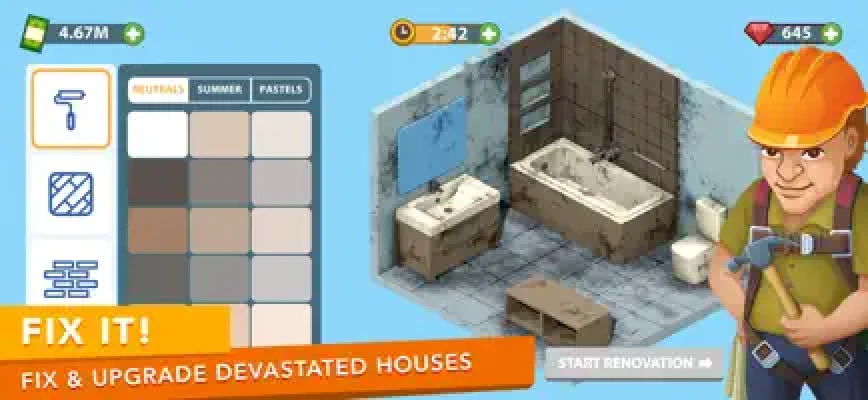
As you work on a property, you can improve different aspects of the home and transform a neglected building into something more attractive and valuable.
Renovation decisions can involve:
- Repairs
- Interior improvements
- Exterior improvements
- Paint
- Landscaping
- Furniture and decorations
- Property upgrades
- Higher-end improvements
The App Store describes the game as a simulation of renovating fixer-upper houses and developing the skills needed to make profitable offers.
Interior Design and Customization
FlippIt isn't only about financial calculations.
There is also a creative side to renovating properties.
You can change the appearance of houses and make design choices that help create a more attractive property.
Paint, trees, upgrades, and other visual improvements can affect how you approach each renovation.
This gives the game a combination of:
Home Design + Renovation + Real Estate + Management.
Understanding Buyer Requirements
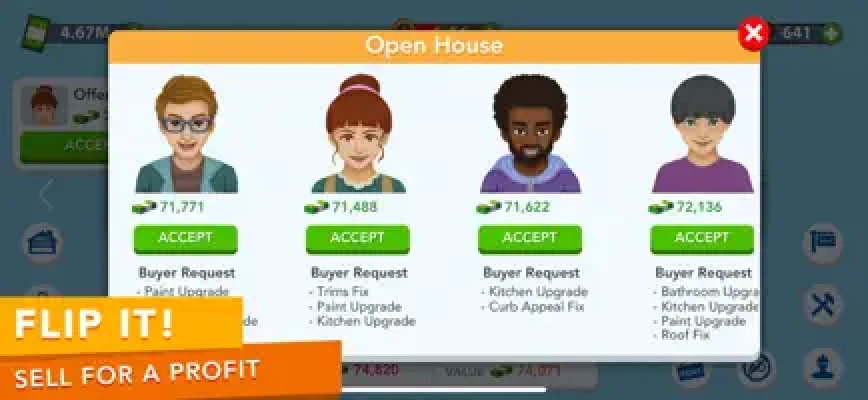
One of the game's most important mechanics is understanding what potential buyers want.
Different buyers can have different requirements, so simply making a house look good is not always enough.
You need to pay attention to their preferences and complete the necessary tasks within the available time.
A renovation that looks impressive to you may not necessarily be the most profitable option if it doesn't match what the target buyer wants.
Selling Your Properties
Once renovation work is complete, you can attempt to sell the property.
The goal is to earn more than you invested.
Your potential return depends on how effectively you manage the entire process:
Purchase cost + renovation expenses + time management = investment decision.
The best outcome is not necessarily the most expensive renovation.
A successful investor needs to understand when an upgrade is worth its cost and when additional spending could reduce the final profit.
Renting Properties
FlippIt also gives you the option to rent properties instead of immediately selling them.
This adds another layer to property management.
Instead of receiving a single return from a sale, rental properties can become part of a longer-term investment strategy.
This makes the game more than a simple house-flipping simulator because you have to consider different ways of generating value from your properties.
Building a Real Estate Portfolio
Your objective can extend beyond completing one house.
Successful property decisions allow you to build a larger portfolio and continue investing in new opportunities.
As your experience grows, you can think more strategically about:
- Which houses to buy
- Which renovations to prioritize
- When to sell
- When to rent
- How much to invest
- How quickly to reinvest profits
The portfolio system gives the game a longer-term progression loop.
Managing Renovation Costs
Money management is critical.
Every renovation decision represents an investment.
Spending heavily on upgrades can increase the property's appeal, but excessive spending can reduce your profit.
A smart approach is to ask:
Will this improvement generate enough additional value to justify its cost?
That question captures much of FlippIt's business-oriented gameplay.
Time Management
Time is another resource you need to manage.
The game gives you tasks that may have time constraints, and delays can affect your progress or profits.
This means that simply completing every possible improvement isn't always the ideal strategy.
You need to prioritize the work that matters most.
Disasters and Unexpected Problems
FlippIt adds uncertainty through unexpected disasters.
According to the App Store description, disasters can occur during the renovation process and may cause delays or reduce potential profits.
These events prevent the game from becoming a completely predictable renovation checklist.
A good investment can suddenly require a different response when an unexpected problem appears.
High-End Renovations
Experienced players can experiment with higher-end property improvements.
The game's renovation system gives you opportunities to improve properties to more valuable standards.
However, premium improvements should be considered carefully because higher spending does not automatically guarantee better returns.
The best strategy depends on the property's potential, the target buyer, and your overall budget.
Managers and Property Management
Property management is another part of FlippIt's progression.
Managers can help with the broader business side of property ownership, although the current App Store reviews show that some players have concerns about the cost and availability of manager-related features.
This is worth considering if you plan to build a large portfolio rather than simply complete individual renovation projects.
Beginner's Guide to FlippIt
Start With the Numbers
Before spending heavily on a property, think about its potential return.
Don't assume that the most expensive renovation will automatically create the highest profit.
Complete Important Repairs First
Focus on necessary repairs before spending heavily on cosmetic improvements.
A property needs to be functional before you worry about making it luxurious.
Understand the Buyer
Pay attention to buyer requirements.
Their preferences should influence how you renovate the property.
Watch Your Budget
Keep enough resources available for unexpected problems.
A disaster or additional repair can quickly change your financial calculation.
Compare Selling and Renting
Don't automatically sell every property.
Consider whether renting makes sense for your current portfolio strategy.
Reinvest Carefully
Once you make a profit, don't immediately spend everything.
Use your earnings to create a stronger financial position for future properties.
Advanced FlippIt Strategy
Calculate Your Potential Profit
Before purchasing a property, estimate:
Expected sale value − purchase price − renovation costs = potential gross profit.
The calculation won't account for every variable in the game, but it provides a useful framework for making decisions.
Avoid Unnecessary Upgrades
Not every improvement provides equal value.
If a renovation is expensive but has little impact on the property's attractiveness or profitability, your money may be better spent elsewhere.
Build a Balanced Portfolio
Owning different types of properties can give you more flexibility.
Some properties may be better suited to selling, while others may work better as rental investments.
Plan Around Time Limits
Prioritize tasks that are necessary for completing the current objective.
Delaying important work can reduce your ability to generate profit.
Keep Emergency Resources
Unexpected disasters can create additional expenses.
Having financial flexibility can prevent one problem from damaging an otherwise successful investment.
Game Modes and Activities
FlippIt is centered around its property-investment simulation rather than traditional combat or level-based gameplay.
Major activities include:
- Buying properties
- Repairing houses
- Renovating interiors
- Improving exteriors
- Decorating properties
- Managing buyer requirements
- Selling houses
- Renting properties
- Managing investments
- Building a real-estate portfolio
- Responding to unexpected events
- Competing for stronger investment results
House Flipping Strategy
House flipping is fundamentally about buying a property at a price that leaves room for improvement and profit.
FlippIt turns this concept into a game loop.
A successful flip requires more than making a house attractive.
You have to consider the relationship between:
Purchase Price → Renovation Budget → Buyer Demand → Selling Price → Profit.
Understanding this relationship is what separates careful property management from simply spending money on decorations.
Rental Property Strategy
Selling isn't always the only way to benefit from a property.
Rental properties can provide another path for your investment portfolio.
Consider renting when:
- The property has strong rental potential.
- Immediate selling would produce a weaker return.
- You want to expand your portfolio.
- You prefer longer-term property management.
The ideal choice depends on the current property and your overall investment strategy.
Home Design Experience
For players who enjoy interior design, FlippIt provides a creative alternative to purely business-focused simulation games.
You can experiment with the appearance of properties while also thinking about their financial value.
This combination makes the game appealing to players who enjoy both:
- House renovation games
- Real-estate simulation games
- Home design games
- Property management games
Visual Style
FlippIt's visual presentation focuses on houses, properties, renovations, and investment management rather than character-driven storytelling.
The main visual satisfaction comes from seeing a neglected property gradually become a more attractive home.
That before-and-after transformation is an important part of the game's appeal.
Main Features
- House flipping simulation
- Fixer-upper properties
- Real-estate investment
- Home renovation
- Interior design
- Property management
- House selling
- Rental properties
- Buyer requirements
- Time-based tasks
- Unexpected disasters
- Property portfolio building
- High-end upgrades
- Financial decision-making
- Casual simulation gameplay
- iPhone and iPad support
These features are based on the current App Store listing.
Controls and Interface
FlippIt's mobile gameplay is designed around straightforward management and renovation interactions.
Players can navigate their properties, select renovation tasks, manage improvements, monitor investments, and make decisions about selling or renting.
The game is designed for touch-screen devices and is available on iPhone and iPad.
Difficulty
FlippIt is easy to understand at first because its basic objective is familiar:
Buy a property, improve it, and make money.
The difficulty increases when you begin balancing several factors simultaneously.
You need to understand:
- Renovation costs
- Buyer requirements
- Time limits
- Property value
- Rental income
- Potential sale prices
- Unexpected problems
- Resource management
The deeper challenge comes from making profitable decisions rather than simply completing renovation tasks.
Player Experience
The current U.S. App Store listing shows FlippIt with a 4.5 out of 5 rating from more than 300 ratings.
Positive reviews highlight the combination of home renovation, creativity, property investment, and business management. Some players particularly appreciate being able to choose between selling and renting properties.
Other reviews mention concerns about the game's gem economy, waiting periods, upgrade costs, and occasional progression problems. These points are useful to keep in mind when describing the overall experience.
Updates and Development
The App Store version history shows continued maintenance and performance work.
Recent versions include:
- Version 10.5.3 – bug fixes
- Version 10.5.2 – performance enhancement
- Version 10.5.1 – text bug fixes
- Version 10.5 – bug fixes
The version history also shows earlier updates that introduced new houses, income properties, performance improvements, and other fixes.
Technical Information
Game: FlippIt – House Flipper Games
Developer: Advanced Studio LLC
Category: Simulation
Platform: iPhone and iPad
Price: Free
In-App Purchases: Yes
Age Rating: 4+
Current App Size: Approximately 521.1 MB
Language: English
Required iOS: iOS 15.0 or later
Required iPadOS: iPadOS 15.0 or later
Mac Support: macOS 12.0 or later with Apple M1 chip or newer
Apple Vision Support: visionOS 1.0 or later
These technical specifications reflect the current U.S. App Store listing and may change with future updates.
In-App Purchases
The current listing shows optional purchases including:
- Gems Pack 1 – $2.99
- Gems Pack 2 – $5.99
- Remove Ads – $4.99
- Gems Pack 3 – $9.99
- Gems Pack 4 – $19.99
- Gems Pack 5 – $49.99
- Gems Pack 6 – $99.99
- Promotional offer – $79.99
The game remains free to download, with these optional purchases available to speed up progression or increase resources.
Pros and Cons
Pros
- Interesting house-flipping concept
- Combines renovation and real-estate management
- Buy, renovate, sell, or rent properties
- Creative home improvement
- Buyer requirements add strategy
- Unexpected disasters create variety
- Portfolio-building progression
- Free to download
- Works on iPhone and iPad
Cons
- Optional purchases can become expensive
- Gem management may affect progression
- Some upgrades require significant resources
- Waiting can interrupt progression
- Unexpected problems can delay renovations
- The game is relatively large for a mobile simulation
Who Should Play FlippIt?
FlippIt is a good choice for players who enjoy:
- House renovation games
- House flipping games
- Real-estate simulation
- Property management
- Interior design
- Home improvement games
- Business simulation
- Tycoon-style games
- Casual management games
- Investment strategy
It is particularly appealing if you enjoy watching renovation projects transform from neglected properties into more valuable homes.
Who Might Not Enjoy FlippIt?
The game may be less suitable for players who prefer:
- Fast-paced action
- Story-heavy games
- Offline experiences
- Completely free progression
- Realistic property simulation
- Competitive multiplayer
Its focus is on casual property management and renovation rather than action or narrative gameplay.
FlippIt vs Traditional House Flipper Games
Traditional house renovation games often focus primarily on cleaning, repairing, decorating, and selling individual properties.
FlippIt adds a stronger real-estate investment layer.
You are not only renovating a house—you are thinking about:
How much should I spend?
Who will want this property?
Should I sell it or rent it?
How can I build a larger portfolio?
That business-oriented approach gives FlippIt its own identity within the house renovation genre.
Why FlippIt Is Interesting
The appeal of FlippIt comes from the transformation of an ordinary property into a financial opportunity.
You start with a fixer-upper.
You make decisions about repairs and design.
You deal with unexpected problems.
You consider the preferences of potential buyers.
Then you decide whether your work has created enough value to sell or whether the property should become part of your rental portfolio.
That combination of creativity and financial decision-making makes each property feel like a small investment puzzle.
Tips for Making More Profit
Buy With a Plan
Don't purchase a property simply because it looks cheap.
Think about what it could become.
Prioritize Necessary Work
Complete critical repairs before spending heavily on decorative improvements.
Know Your Target Buyer
Buyer requirements can influence the profitability of a renovation.
Don't Overspend
A beautiful property can still be a bad investment if the renovation costs are too high.
Consider Renting
A property doesn't always have to be sold immediately.
Watch for Disasters
Unexpected problems can affect both time and profit, so keep some resources available.
Reinvest Profits
Use successful flips to strengthen your ability to take on better properties.
Frequently Asked Questions
What is FlippIt – House Flipper Games?
FlippIt is a real-estate simulation game where players buy fixer-upper houses, renovate them, manage properties, and attempt to make a profit by selling or renting them.
Is FlippIt available on iPhone?
Yes. FlippIt is available for iPhone and iPad through the App Store.
Is FlippIt free?
Yes. The game is free to download and includes optional in-app purchases.
Can you sell houses in FlippIt?
Yes. Selling renovated properties for a profit is one of the game's central mechanics.
Can you rent houses in FlippIt?
Yes. Players can choose to rent properties rather than immediately selling them, adding a longer-term investment option.
What do you do in FlippIt?
You buy properties, repair and renovate them, respond to buyer requirements, manage time and resources, and then sell or rent the finished properties.
Can you decorate houses in FlippIt?
Yes. Renovation and design are important parts of the gameplay, with improvements to properties and visual customization.
Does FlippIt have unexpected events?
Yes. Disasters can occur during the renovation process and may cause delays or affect profits.
Does FlippIt have in-app purchases?
Yes. The current App Store listing includes several optional gem packs and a remove-ads purchase.
What iOS version does FlippIt require?
The current listing requires iOS 15.0 or later on iPhone and iPadOS 15.0 or later on iPad.
Is FlippIt an online multiplayer game?
The core experience is a property-management and renovation simulation rather than a traditional real-time multiplayer game.
Final Verdict
FlippIt – House Flipper Games is a casual property-investment simulator that combines home renovation with the business decisions behind buying, selling, and renting real estate.
Its strongest feature is the way it turns each house into an investment puzzle. You need to decide how much to spend on repairs, which improvements are worthwhile, what potential buyers want, and whether selling or renting makes more sense.
The renovation side provides a creative outlet, while the property-management systems add a layer of strategy.
If you enjoy house flipping games, home renovation simulators, real-estate games, property management, and interior design, FlippIt offers an accessible mobile experience that lets you build your own virtual property portfolio.
Rate the Game
User Reviews








Popular Games



















 Android
 iOS
iOS Windows
 Xbox
Xbox