








Latest Version
January 23, 2026
H2T GLOBAL PTE. LTD.
Action
0
Report a Problem
More About :game
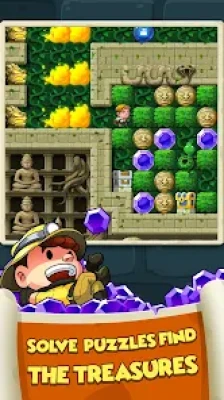
The adventure takes you through the jungles of Angkor Wat, the dungeons of Bavaria Castle, and the icy caves of Tibet. Along the way, you must cut through vegetation, break cobwebs, manipulate objects, avoid enemies and survive environmental hazards.
The game's central idea is right in its name: Don't Rush! Careless movement can turn a simple-looking room into a dangerous trap.
What Is Diamond Quest: Don't Rush!?
Diamond Quest: Don't Rush! is a single-player action-adventure puzzle game that combines classic treasure hunting with platforming and environmental challenges.
The objective in each area is to collect the required gems and find a route toward the exit. Getting there requires more than simply walking forward. You may need to move objects, break barriers, cross water, avoid creatures or use one of several special tools.
The game currently has an Everyone rating on Google Play and supports offline play. It is also listed for Android and Windows.
Main Features
- Adventure exploration across three major environments
- Angkor Wat jungle areas
- Bavaria Castle dungeons
- Icy caves of Tibet
- Hundreds of puzzle challenges
- Diamond and gem collecting
- Environmental obstacles
- Dangerous traps
- Snakes, turtles, bombs and monkeys
- Water exploration sections
- Checkpoint system
- Large boss encounters
- Mystic Hammer
- Mystic Hook
- Freeze Hammer
- Stylized HD graphics
- Adventure-themed music and sound
- Offline gameplay
- Single-player experience
How the Gameplay Works
Each room presents a combination of exploration, collectibles and hazards.
Your goal is usually to gather the necessary diamonds and reach the exit. However, the route may be blocked by weak walls, vegetation, cobwebs, objects or enemies.
Some obstacles can be handled directly, while others require one of the game's Mystic Tools.
The important thing is to understand the room before making a move.
A diamond sitting in front of you isn't necessarily a free reward. It could be positioned next to a trap or trigger an environmental event.
Full Strategy Guide
1. Remember the Golden Rule: Don't Rush
The biggest mistake beginners make is treating the game like a traditional fast platformer.
Instead, stop whenever you enter a new room.
Look around for:
- Diamonds
- Hidden passages
- Enemies
- Falling objects
- Weak walls
- Water routes
- Traps
- Checkpoints
- Interactive objects
Once you understand the room, choose your route.
2. Study the Environment First
Before collecting a visible diamond, determine what surrounds it.
Ask yourself:
- Is there an enemy nearby?
- Can a boulder fall onto this position?
- Is there a safe way back?
- Will collecting the diamond change the room?
- Is this actually the intended route?
This simple habit can prevent many unnecessary deaths.
3. Use the Checkpoint System
Checkpoints are extremely useful during difficult sections.
Once you activate or reach a checkpoint, use the next part of the level as a learning exercise.
If you fail, remember exactly what caused the mistake.
Instead of repeating the same action, change your timing or route.
4. Be Careful With Boulders
Gravity plays an important role in several puzzles.
The game specifically features precariously balanced boulders that can fall and crush creatures or the player.
Before disturbing a nearby object, look at the possible path of the boulder.
A falling boulder can sometimes be a threat, but it can also become a useful tool for eliminating an enemy or clearing an area.
5. Don't Treat Every Enemy as a Fight
Not every creature needs to be confronted directly.
Enemies can sometimes be avoided by waiting for the correct opening.
Watch their movement patterns.
If a snake, monkey or other creature moves back and forth, wait until it leaves your intended path before proceeding.
Patience is often safer than trying to squeeze past an enemy.
6. Use the Mystic Hammer
The Mystic Hammer is designed to break weak walls.
If you encounter a suspicious wall, examine the surrounding area before using the tool.
Breaking a wall may reveal:
- A hidden diamond
- A shortcut
- A new route
- An enemy
- Another puzzle
- A safer way forward
Don't assume every breakable wall should be destroyed immediately.
7. Master the Mystic Hook
The Mystic Hook allows you to drag objects.
This makes it particularly useful for environmental puzzles.
Before moving an object, think about where it needs to end up.
A common puzzle-solving mistake is moving something simply because it can be moved.
Instead, ask:
What problem does this object need to solve?
Then position it accordingly.
8. Use the Freeze Hammer Strategically
The Freeze Hammer can freeze targets.
Rather than using it immediately, look for situations where temporarily stopping something gives you a safe window to pass.
It can be especially useful when an enemy or moving obstacle repeatedly interferes with your route.
9. Learn to Read Traps
The game includes several different hazards, including:
- Snakes
- Turtles
- Bombs
- Monkeys
- Falling boulders
- Environmental obstacles
Don't assume that every hazard is triggered in the same way.
When something goes wrong, identify what activated it.
Once you understand the trigger, the next attempt becomes much easier.
10. Don't Ignore Water Sections
Some areas require you to dive into water.
Water routes can completely change the way a room is solved.
Before entering:
- Identify where you need to go.
- Look for the exit point.
- Check for nearby hazards.
- Search for collectibles.
- Avoid unnecessary movement.
If you're unsure where the underwater route leads, explore carefully rather than rushing forward.
Diamond Collection Strategy
Diamonds are central to progression.
However, collecting every visible gem immediately isn't always the safest approach.
A better method is:
Observe → Plan → Collect → Escape
First understand the room.
Then decide whether collecting a particular diamond creates a risk.
Some collectibles are placed in locations that require you to interact with the environment before they can be safely reached.
Puzzle-Solving Techniques
Think Backward
If you can see the exit but can't reach it, start from the end.
Ask:
What needs to happen immediately before I can reach the exit?
Then work backward until you discover the required sequence.
Change One Element at a Time
If a room contains several movable objects, avoid changing everything simultaneously.
Move one object.
Observe the result.
Then make the next decision.
This makes complicated puzzles much easier to understand.
Search the Edges of the Room
Important items aren't always placed directly along the obvious route.
Check:
- Corners
- Upper areas
- Side paths
- Behind vegetation
- Weak walls
- Areas blocked by cobwebs
Exploration is part of the puzzle.
Angkor Wat Strategy
The Angkor Wat section provides the classic jungle-adventure atmosphere.
Expect vegetation, creatures, obstacles and ancient temple-style environments.
Tips for Angkor Wat
- Explore side areas carefully.
- Watch for creatures before crossing narrow paths.
- Cut through vegetation when necessary.
- Look for hidden diamonds.
- Examine suspicious walls.
- Don't run beneath unstable objects.
- Use checkpoints as safe learning points.
The jungle may look open, but many rooms are designed around carefully choosing the correct route.
Bavaria Castle Strategy
Bavaria introduces a more enclosed dungeon atmosphere.
Castle rooms can make environmental positioning particularly important.
Tips for Bavaria
- Examine each room before moving objects.
- Be careful around bombs and other hazards.
- Look for alternative routes.
- Use tools only when you understand their purpose.
- Keep track of your return route.
- Don't trap yourself by moving an object into the wrong position.
In tight rooms, one incorrect move can turn a safe route into a dead end.
Tibet Cave Strategy
The icy caves provide a different environment and introduce challenging exploration sections.
Tips for Tibet
- Move slowly through unfamiliar areas.
- Watch for environmental hazards.
- Pay attention to water routes.
- Search carefully for diamonds.
- Use checkpoints whenever available.
- Avoid unnecessary risks when returning through previously explored areas.
The safest path isn't always the shortest one.
Boss Battle Guide
At the end of each major map, you'll face a boss monster.
Boss fights can be intimidating because of the boss's size and attack patterns, but the best strategy is usually observation.
Before Attacking
Watch the boss.
Look for:
- Repeated movement
- Attack timing
- Safe positions
- Vulnerable moments
- Environmental objects
- Opportunities to use special tools
During the Fight
Don't continuously attack just because the boss is nearby.
Instead:
- Observe the attack.
- Move into a safe position.
- Wait for the opening.
- Attack or interact.
- Retreat if necessary.
- Repeat the pattern.
Survival should come before speed.
How to Avoid Losing Progress
The checkpoint system allows you to return to a recent safe point.
Use checkpoints as part of your overall strategy.
When you reach one, mentally divide the level into two sections:
Completed section → New challenge
This reduces frustration because you don't have to relearn the entire level after every mistake.
Beginner Tips
- Don't rush through unexplored rooms.
- Look around before collecting diamonds.
- Watch enemy movement patterns.
- Learn what each Mystic Tool does.
- Be careful around unstable boulders.
- Search behind walls and vegetation.
- Use checkpoints to learn difficult sections.
- Don't move puzzle objects randomly.
- Study boss patterns before attacking.
- Take water sections slowly.
- Look for alternative routes.
- Learn from every failed attempt.
Graphics and Atmosphere
Diamond Quest: Don't Rush! uses stylized HD visuals to create three distinct adventure settings.
The jungle areas emphasize ancient ruins and exploration, Bavaria provides dungeon-style environments, and Tibet delivers an icy cave setting.
Music and sound effects help reinforce the adventure atmosphere while making hazards and exploration feel more active.
Controls and Gameplay Feel
The game's controls are designed to keep the interaction relatively accessible while putting most of the challenge into movement, timing and puzzle solving.
The real difficulty comes from deciding where to go and when to move.
This makes the game particularly suitable for players who enjoy adventure games where observation and patience matter as much as reflexes.
Progression
Diamond Quest: Don't Rush! uses a map-based adventure structure.
As you progress, the game introduces different environments, hazards and puzzle combinations.
The challenge isn't simply about collecting diamonds. Later sections require you to combine environmental awareness, tool usage, enemy timing and route planning.
Offline Gameplay
Google Play currently lists the game as Offline, so it can be played without a continuous internet connection.
Game Information
Game Title: Diamond Quest: Don't Rush!
Developer: H2T GLOBAL PTE. LTD.
Package Name: diamond.quest.dont.rush
Genre: Action / Action-Adventure / Casual
Mode: Single player
Content Rating: Everyone
Platforms: Android and Windows
Offline Play: Yes
Contains: Ads and in-app purchases
Latest listed update: August 17, 2026
Google Play Downloads: 10M+
Google Play Rating: 4.3 stars
The current Google Play listing confirms the 10M+ download milestone, 4.3-star rating, Everyone rating, offline availability, Android/Windows support and August 17, 2026 update.
Player Reception
The game currently has a large player base, with hundreds of thousands of Google Play reviews.
Recent player feedback includes nostalgia from people who remember playing the original-style adventure on older phones. Other reviews have raised complaints about advertising and particular gameplay or progress issues. These are individual player experiences and shouldn't be treated as universal problems.
Pros and Cons
Pros
- Large adventure with multiple environments
- Lots of puzzle challenges
- Diamond-collecting objectives
- Interesting environmental hazards
- Mystic Tools add variety
- Boss encounters
- Checkpoint system
- Offline support
- Nostalgic adventure style
- Android and Windows availability
Cons
- Some puzzles can require repeated attempts
- Certain hazards are unforgiving
- Ads are included
- In-app purchases are available
- Some players have reported issues with advertisements or progression
Frequently Asked Questions
What is Diamond Quest: Don't Rush!?
Diamond Quest: Don't Rush! is an action-adventure puzzle game focused on collecting diamonds, exploring dangerous environments, solving puzzles and defeating bosses.
Where does Diamond Quest: Don't Rush! take place?
The game features three major settings: the jungles of Angkor Wat, the dungeons of Bavaria Castle and the icy caves of Tibet.
What are the Mystic Tools?
The game includes the Mystic Hammer for breaking weak walls, the Mystic Hook for dragging objects and the Freeze Hammer for freezing targets.
Does Diamond Quest have boss battles?
Yes. Boss monsters appear at the end of maps and must be overcome before progressing to the next location.
Can you play Diamond Quest offline?
Yes. Google Play currently lists the game as an offline title.
Does Diamond Quest have puzzles?
Yes. Puzzle solving is a major part of the game, with environmental obstacles, movable objects, traps and routes that require careful planning.
Is Diamond Quest suitable for children?
Google Play currently gives the game an Everyone content rating.
Is Diamond Quest: Don't Rush! available on Windows?
Yes. Google Play currently lists Android and Windows as supported platforms.
Final Thoughts
Diamond Quest: Don't Rush! combines treasure hunting, environmental puzzles and classic adventure gameplay into a journey across jungles, castles and icy caves.
Its most important mechanic isn't a weapon or special ability—it's patience. The title's warning is genuinely useful: rushing into a room without understanding the hazards can quickly turn a simple puzzle into a failed attempt.
For players who enjoy diamond collecting, adventure puzzles, exploration, traps, boss fights and classic-style platforming, the game offers a substantial collection of challenges with several different environments to explore.
Rate the Game
User Reviews















Popular Games



















 Android
 iOS
iOS Windows
 Xbox
Xbox