


Latest Version
September 09, 2024
Homa
Strategy
0
com.SLOWMO.CrowdDefense
Report a Problem
More About :game
The game combines elements of crowd control, base defense, tactical positioning and quick decision-making. Its simple presentation makes it easy to understand, but choosing where to place your units becomes increasingly important as the enemy pressure grows.
The current version is 2.1.0, with the latest recorded update dated May 14, 2026. Recent tracking data puts the game above 38 million downloads, while the Google Play tracking rating is around 3.0 from more than 27,000 ratings.
What Is City Defense?
City Defense is a police-themed strategy game centered around defending a city from an advancing crowd.
Your objective is simple:
Deploy your forces → Draw your defense → Stop the crowd → Protect the city
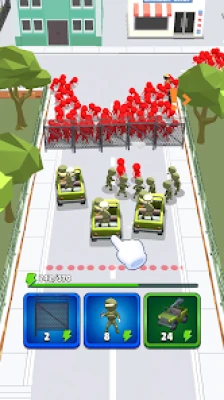
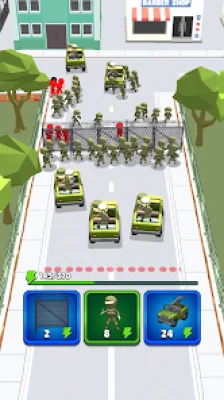
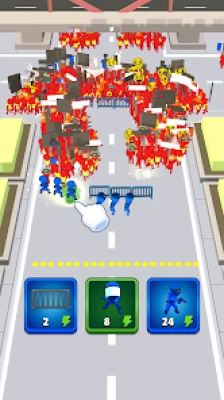
The game uses red-versus-blue battles and gives you police and military-style units to push back the incoming enemies. The official game description focuses on drawing defensive lines, positioning officers and soldiers, cloning or expanding your forces, and preventing the crowd from taking control of the city.
City Defense Gameplay
The gameplay revolves around making tactical decisions before the enemy reaches your defensive position.
You need to determine where your units will be most effective and how to use the available battlefield space.
A successful defense usually requires three things:
Good unit placement
Efficient use of available resources
Controlling the enemy's movement
Simply putting every soldier in one location is rarely the best approach.
Instead, create a defense that can handle different directions of attack.
How to Play City Defense
Each stage presents a defensive situation.
Your enemies approach while you prepare your forces.
You can position units and establish defensive lines to control where the opposing crowd can move.
The basic process is:
Examine the battlefield.
Identify the main enemy approach.
Place your first defensive units.
Protect important areas.
Add additional soldiers as resources become available.
Stop the enemy advance.
Strengthen your forces between stages.
The game rewards players who think about positioning instead of simply deploying units as quickly as possible.
City Defense Strategy
The most important strategy is to control the battlefield rather than chase individual enemies.
When a large crowd is approaching, your goal should be to create a defensive structure that forces enemies into areas where your units can deal with them efficiently.
Think about the battlefield as a series of zones.
Front Zone
This is where you initially slow the enemy.
Middle Zone
This is where your main defensive force should operate.
Final Zone
This area must remain protected in case some enemies break through.
Keeping a final defensive layer gives you room to recover from mistakes.
Best Defense Line Strategy
The defense line is one of the defining mechanics of City Defense.
Rather than placing units randomly, use your line to influence the enemy's route.
A good defense line should:
Slow incoming enemies
Keep them away from vulnerable areas
Give your units enough time to attack
Prevent enemies from spreading too widely
Create favorable positions for your strongest units
Avoid making your defensive structure unnecessarily complicated.
A simple line in the correct location can be much more effective than a complicated setup in the wrong place.
Police and Soldier Placement
Positioning is more important than simply having a large number of units.
When deciding where to place a soldier, consider:
Enemy direction
Distance to the protected area
Number of opponents
Available space
The unit's role
Potential attack routes
Try to place your strongest defensive units where the enemy concentration is highest.
Do not waste powerful units on an area where only a few enemies are likely to appear.
How to Stop Large Crowds
Large crowds can be intimidating because they can overwhelm isolated units.
The best response is usually to concentrate your defensive strength at important points.
Instead of spreading your forces evenly across the entire map, identify the locations where the crowd is most likely to break through.
Then reinforce those positions.
This creates a stronger defensive line without wasting your available forces.
City Defense Resource Management
Some versions and descriptions of the game include different unit types with varying resource or energy costs. One documented gameplay breakdown describes barriers, infantry and snipers with different deployment costs and slow resource recovery.
This makes resource management an important part of the strategy.
Do not spend everything immediately.
Save enough resources to respond when the enemy becomes stronger or changes direction.
Why Saving Resources Matters
Imagine that you use all your available resources during the first enemy wave.
Your defense may look strong initially, but if another group appears shortly afterward, you may have no way to reinforce the weak side.
A better approach is:
Deploy → Observe → Reinforce → Counter
This gives you more flexibility.
City Defense Unit Strategy
Different units can serve different purposes.
Barriers
Barriers can help slow down or redirect approaching enemies.
Use them to buy time rather than treating them as your main source of damage.
Infantry
Infantry provides the basic strength of your defensive force.
They are useful for establishing a reliable frontline.
Snipers
Snipers can provide stronger long-range support and are particularly useful when positioned where they can attack approaching enemies safely.
The key is to combine unit roles rather than relying entirely on one type.
How to Use Snipers Effectively
Long-range units should generally be positioned behind the main defensive line.
This gives them more time to attack before enemies reach them.
Avoid placing fragile long-range units directly in front of the enemy.
Instead:
Barrier → Infantry → Sniper
This creates multiple layers of protection.
City Defense Crowd Control
Crowd control is one of the game's central ideas.
You do not always need to destroy enemies immediately.
Sometimes slowing them down is just as important.
A delayed enemy gives your defensive units additional time to attack.
This is why barriers and positioning can be valuable even when they do not directly defeat enemies.
How to Protect the Police Cars
The game specifically warns against allowing the crowd to reach the police vehicles.
Treat the area around the vehicles as your final defensive zone.
If enemies are getting close:
Reinforce the threatened side.
Use slowing defenses.
Concentrate your strongest units.
Stop unnecessary deployments elsewhere.
Focus on the enemies closest to the protected area.
Your priority should always be preventing a breakthrough.
City Defense Beginner Strategy
New players should avoid trying to build a complicated strategy immediately.
Start with a simple defensive structure.
Step 1: Find the Main Attack Route
Determine where the majority of enemies are coming from.
Step 2: Establish a Frontline
Use basic defensive units to slow the advance.
Step 3: Add Damage Dealers
Place stronger offensive units behind the frontline.
Step 4: Watch for Gaps
If one side begins to collapse, reinforce it.
Step 5: Keep Some Resources
Do not spend everything at the beginning.
Step 6: Protect the Final Area
Always keep enough defensive strength to stop enemies that break through.
Advanced City Defense Strategy
Once you understand the basic mechanics, start thinking about enemy flow.
Instead of asking:
"Where should I put my next soldier?"
ask:
"Where do I want the enemy to go?"
That change in thinking can significantly improve your defense.
If you can force the crowd into a narrow area, your units can concentrate their attacks.
If the enemy spreads across the entire map, your defensive force may become too thin.
How to Create a Choke Point
A choke point is a narrow area where you can force multiple enemies to pass through a limited route.
Use:
Barriers
Defense lines
Unit positioning
Natural map boundaries
The objective is to make the enemy's movement predictable.
Once enemies are concentrated, your damage-dealing units become more effective.
City Defense Upgrade Strategy
Between stages, upgrading your forces can improve their effectiveness. A documented game breakdown notes that profits can be invested into improving troop characteristics, with units becoming more developed as they level up.
When deciding what to improve, prioritize the weakness that is actually causing you to lose.
If Enemies Reach Your Base
Improve your frontline and crowd-control capability.
If Your Units Die Too Quickly
Prioritize defensive strength.
If You Cannot Eliminate Enemies Fast Enough
Invest in stronger damage output.
If You Struggle With Large Crowds
Improve the combination of slowing and damage-dealing units.
Do not upgrade randomly.
Best Way to Spend Resources
A strong progression strategy is to maintain balance.
Do not put everything into one unit type if doing so leaves your defense vulnerable elsewhere.
Think in terms of:
Defense + Damage + Crowd Control
A balanced force is usually more reliable than an extremely powerful but narrow strategy.
City Defense Tips and Tricks
Study the battlefield before deploying units.
Identify where the main crowd is coming from.
Create a strong frontline.
Keep powerful units behind the frontline.
Use barriers to slow enemy movement.
Create choke points when possible.
Do not spend every resource immediately.
Keep a reserve for emergencies.
Reinforce weak areas quickly.
Protect the final defensive zone.
Place long-range units behind safer positions.
Focus your forces where the enemy is concentrated.
Avoid spreading your army too thin.
Upgrade the units responsible for your biggest weakness.
Learn from every failed defense.
Common City Defense Mistakes
Deploying Everything Immediately
Using all your resources at the beginning can leave you helpless later.
Spreading Units Too Far Apart
A widely scattered force can be overwhelmed one section at a time.
Ignoring Enemy Routes
Your defense should respond to where enemies are actually moving.
Putting Strong Units in Front
Powerful but vulnerable units may be destroyed quickly if placed directly on the frontline.
Forgetting the Final Defense
Even a strong first line can fail.
Always keep a backup plan.
Upgrading Without a Purpose
Spend your resources on improvements that solve actual problems in your defense.
How to Beat Difficult Levels
When a level becomes difficult, do not immediately assume that you need more units.
First examine your positioning.
Ask:
Where did the enemy break through?
Did I spend resources too early?
Was my frontline too weak?
Were my ranged units exposed?
Did I protect the wrong area?
Did I fail to create a choke point?
Then change one part of your strategy and try again.
This is much more effective than completely changing your defense every time.
City Defense Level Strategy
As the game becomes more demanding, the enemy pressure can require better resource management and stronger positioning.
A useful approach is to divide each stage into three phases.
Phase One: Setup
Build your initial defense without wasting resources.
Phase Two: Stabilization
Watch the enemy and reinforce the locations under pressure.
Phase Three: Final Defense
Save enough power to deal with the last major push.
This prevents the common mistake of winning the early part of a level and losing at the end.
Police vs. Crowd Strategy
The game uses a simple red-versus-blue visual structure to represent the opposing forces.
Do not allow the visual simplicity to make you underestimate the positioning mechanics.
The enemy's numerical advantage can become dangerous if your forces are badly positioned.
Your objective is therefore not simply to match the enemy's numbers.
It is to make your smaller force more efficient.
Is City Defense a Tower Defense Game?
City Defense has several tower-defense-like characteristics, including defensive positioning, resource management, enemy waves and protecting a target.
However, its drawing and crowd-control mechanics give it a more casual and interactive feel than a traditional tower defense game.
It is best described as a casual strategy and city-defense game with crowd-control and tower-defense elements.
City Defense Game Features
Key features include:
Police-themed defense gameplay
Crowd control
City protection
Defensive lines
Soldier deployment
Army management
Enemy crowd battles
Red-versus-blue combat
Barriers and defensive units
Long-range units
Unit upgrades
Tactical positioning
Casual strategy gameplay
The current tracked version is 2.1.0, and the May 14, 2026 update is described as containing minor bug fixes and improvements.
City Defense Controls
The central interaction is drawing and positioning your defensive setup.
This makes the game accessible because you do not need a complicated control scheme.
The challenge comes from deciding where and when to use your forces.
Good positioning can make a simple defensive setup surprisingly effective.
City Defense Difficulty
City Defense is easy to understand but can become more demanding as enemy numbers increase.
Early levels are useful for learning:
Unit placement
Resource management
Defense lines
Crowd control
Upgrade systems
Later challenges require you to combine those mechanics rather than relying on a single unit type.
City Defense Offline and Mobile Play
The game is designed as a mobile experience, and current third-party listings identify Android 7.1+ as the supported minimum operating system for version 2.1.0.
Its short-stage structure makes it suitable for quick gaming sessions.
City Defense Updates
The latest tracked version is 2.1.0, released/updated on May 14, 2026, with minor bug fixes and improvements.
Since the game continues to receive updates, unit balance, levels, performance and gameplay details may change over time.
Player Feedback
City Defense has a very large install base, but its current tracked rating is considerably lower than some other casual strategy games. Recent tracking shows approximately 38 million downloads and a rating around 3.05 from nearly 28,000 ratings.
Player feedback includes positive comments about the basic army-defense concept, while recurring criticism includes advertising, bugs, progression issues and difficult pacing.
This makes the game most appealing to players who enjoy quick casual strategy challenges rather than deep real-time strategy systems.
Pros and Cons
Pros
Simple controls
Easy-to-understand objective
Police and city-defense theme
Crowd-control mechanics
Tactical unit placement
Defense-line system
Upgrade progression
Short gameplay sessions
Large number of levels and challenges
Easy to learn
Cons
Gameplay can become repetitive
Advertising has been criticized by some players
Some players report bugs or crashes
Progression can feel uneven
Strategy depth is more limited than in traditional strategy games
Is City Defense Worth Playing?
City Defense is worth trying if you enjoy casual strategy games where positioning and quick decisions matter.
It is especially suitable for players who like:
Police games
City defense games
Crowd control games
Stickman-style battles
Tower defense games
Army strategy games
Casual tactical games
Base defense games
It is not designed to compete with large-scale real-time strategy games. Its appeal comes from delivering a simple tactical challenge that can be understood quickly.
City Defense Final Verdict
City Defense - Police Games! turns crowd control into a simple but surprisingly tactical mobile experience.
The key to success is not simply deploying as many soldiers as possible. You need to understand where the enemy is coming from, create effective defensive lines, control their movement and keep enough resources available to respond when the situation changes.
The strongest strategy is built around positioning, resource management and layered defense.
Use barriers or frontline units to slow the enemy, place stronger damage dealers behind them, create choke points where possible and always protect the final area around your city.
If you enjoy casual police games, crowd-control challenges, army defense and quick strategy gameplay, City Defense offers a straightforward experience that is easy to learn while still rewarding better tactical decisions.
Frequently Asked Questions
What is City Defense - Police Games?
City Defense is a casual strategy game where you deploy police and soldiers, establish defensive lines and protect a city from large crowds of enemies.
How do you win in City Defense?
Place your units strategically, control enemy movement, conserve resources and prevent the opposing crowd from reaching the protected area.
What is the best City Defense strategy?
Create layered defenses. Use frontline units or barriers to slow enemies while positioning stronger damage dealers behind them.
Should I spend all my resources immediately?
No. Keeping some resources in reserve allows you to reinforce weak areas when the enemy pressure increases.
How do you stop large crowds?
Try to concentrate enemies into narrow areas or choke points, then focus your strongest units on those locations.
What units are available?
Documented gameplay information describes barriers, infantry and snipers with different roles and resource costs.
Can you upgrade soldiers?
Yes. The game includes progression and upgrades that allow your forces to become more effective as you advance.
Is City Defense a tower defense game?
It contains many tower-defense elements, including defensive positioning, enemy waves and protecting a target, but it also uses its own drawing and crowd-control mechanics.
Is City Defense free?
The game is distributed as a free mobile title, with monetization and advertising elements reported in current listings and player feedback.
Who developed City Defense?
City Defense - Police Games! is associated with Homa; the package name is com.SLOWMO.CrowdDefense.
What is the latest version of City Defense?
Current listings identify version 2.1.0 as the latest tracked version, updated May 14, 2026.
Rate the Game
User Reviews












Popular Games



















 Android
 iOS
 Windows
 Xbox