

Latest Version
Visit PageMore About :game
Bounce Defense puts a creative spin on the traditional tower defense formula.
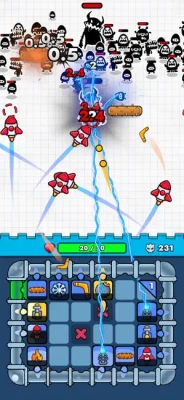
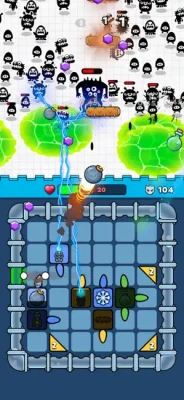
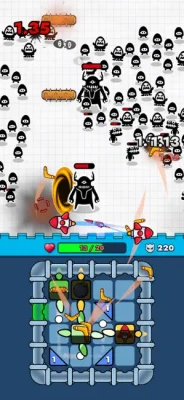
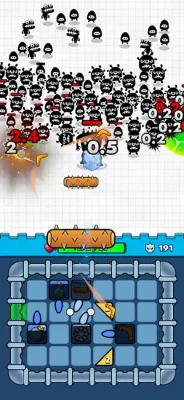
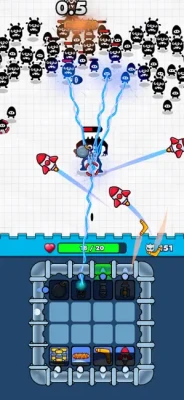
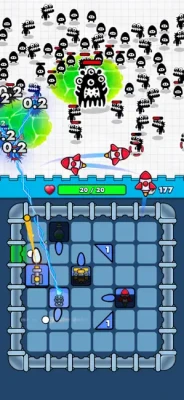
Instead of simply placing towers along a predetermined enemy route, you build a battlefield around bouncers, turrets, lasers, explosives and other weapons. A bouncing ball travels through your carefully designed setup, activating weapons and creating attacks as it moves.
The challenge is figuring out how to construct the most effective combination of objects so that a single bounce can trigger multiple attacks.
This makes Bounce Defense feel like a combination of tower defense, physics puzzle, pinball and strategy gameplay.
Bounce Defense Gameplay Overview
The main gameplay loop is built around planning, placement and chain reactions.
Enemies arrive in increasingly difficult waves. Before and during combat, you need to think about where your defensive objects should be positioned and how the ball will travel between them.
A strong setup can make the ball repeatedly ricochet around the battlefield, activating several weapons and causing devastating combinations.
The longer you survive, the more challenging the enemy waves become, forcing you to continually improve your battlefield and upgrade your weapons.
Main Features
- Physics-based tower defense gameplay
- Tactical grid-based battlefield
- Bouncing ball combat system
- Bouncer blocks for controlling trajectories
- Turrets and laser weapons
- Explosive weapons
- Chain reactions and ricochets
- Weapon upgrades
- Increasingly difficult enemy waves
- Neon-inspired visuals
- Explosive combat effects
- Strategic placement mechanics
- Offline-friendly gameplay
- Short sessions with replayability
- Free-to-play with optional purchases
How to Play Bounce Defense
1. Study the Battlefield
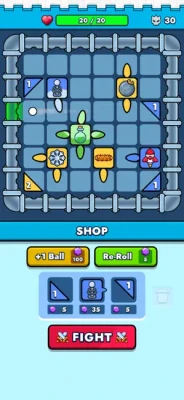
Before committing to a setup, look at the available grid and think about how the bouncing ball could travel through it.
2. Place Bouncers
Bouncer blocks help redirect the ball. Their positioning is extremely important because a well-placed bouncer can send the ball toward another weapon.
3. Add Weapons
Place turrets, lasers, explosives and other available weapons in positions where the ball can activate them effectively.
4. Create a Chain Reaction
The goal is not simply to activate one weapon. Try to create a sequence in which one bounce leads to another activation, producing multiple attacks.
5. Defeat Enemy Waves
Once your setup is ready, put it to the test against incoming enemies.
6. Upgrade Your Defenses
Improve your weapons and adjust your strategy as enemies become stronger.
Physics-Based Strategy
Physics is the heart of Bounce Defense.
Every bounce matters because the trajectory of the ball determines which weapons it can activate. A small change in the position of a bouncer can completely alter the path.
This creates a puzzle-like element within the tower defense format. You are not only asking "Which weapon should I use?" but also "Where should I put it so the ball reaches it at the right moment?"
Tactical Grid Building
The grid gives players a limited space in which to construct their defenses.
Good placement can turn the battlefield into a carefully engineered machine where the ball travels through multiple defensive points.
Poor placement can leave weapons inactive or create inefficient trajectories.
This is one of the game's most distinctive strategic elements.
Weapons and Defenses
Bounce Defense features several types of defensive equipment.
Bouncers
Bouncers redirect the ball and help determine its trajectory. They are essential for creating longer and more complicated attack paths.
Turrets
Turrets provide offensive firepower when activated and can become important parts of a balanced defensive setup.
Lasers
Laser weapons add another method of attacking enemies and can be particularly useful when incorporated into a carefully designed chain.
Explosive Weapons
Explosives create powerful bursts of damage and can help clear groups of enemies.
The official game description specifically highlights bouncer blocks, turrets, lasers and explosive weapons as core defensive tools.
Chain Reactions
Chain reactions are arguably the most satisfying part of Bounce Defense.
Rather than relying on a single weapon, you can build a sequence where the ball activates one defensive element after another.
The game also gives weapons different cooldowns, effects and timing considerations, meaning that simply placing everything together is not always the best strategy.
The strongest setups are carefully planned around timing, trajectory and weapon synergy.
Upgrade System
Upgrading your defenses is an important part of long-term progression.
The game allows players to improve weapons, increase damage and modify the effectiveness of their setups. As enemy waves become tougher, upgrading becomes increasingly important.
A good strategy is to upgrade weapons that already work well with your preferred battlefield design rather than spreading resources too thinly.
Enemy Waves
Bounce Defense uses increasingly difficult enemy waves to test your defensive construction.
Early encounters give you room to learn the physics and understand the available equipment. Later waves put greater pressure on your setup, requiring stronger weapons and better positioning.
The longer you survive, the more demanding the action becomes.
Strategy and Tips
Think About the Ball's Entire Route
Don't focus only on the first bounce. Try to visualize where the ball will travel afterward and which weapons it can activate.
Build for Multiple Activations
A strong defense should ideally allow the ball to trigger several weapons rather than reaching only one attack point.
Use Bouncers Carefully
Too many bouncers can make your setup complicated without necessarily making it stronger. Every bounce should have a purpose.
Experiment With Weapon Placement
Sometimes moving a weapon by one grid position can completely change its effectiveness.
Consider Cooldowns
Weapons have different cooldowns and effects, so timing matters. A setup that looks powerful on paper may perform poorly if its weapons cannot activate at useful intervals.
Learn From Failed Runs
If your defense collapses, examine what happened. Was the ball missing important weapons? Were enemies surviving too long? Did your setup lack enough damage?
Use that information to redesign the battlefield.
Beginner's Guide
If you are new to Bounce Defense, don't worry about creating the perfect setup immediately.
Start by learning how each bouncer changes the ball's movement. Once you understand the physics, introduce offensive weapons one at a time.
Focus on creating a reliable route before trying to build extremely complicated chains.
A simple setup that activates consistently is usually more useful than an elaborate arrangement that rarely works.
Advanced Strategy
Experienced players can begin optimizing their setups around weapon timing, bounce angles and repeated activations.
Try to create paths that maximize the number of useful interactions before the ball exits its effective route.
You should also consider whether combining defensive elements or leaving them separate produces better results. Player feedback specifically notes that decisions involving tower combinations and angle pieces can have a significant effect on damage output.
Game Difficulty
Bounce Defense is easy to understand but becomes more demanding as you progress.
The physics are approachable, but creating an efficient defense requires experimentation. Player reviews have praised the simple mechanics while also mentioning that later progression and tower leveling can become challenging.
The difficulty therefore comes less from complicated controls and more from making the right strategic decisions.
Graphics and Visual Style
The game uses a bright, stylized visual presentation with neon-inspired elements and explosive effects.
The combination of colorful projectiles, bouncing objects and screen-shaking explosions helps make successful chain reactions feel particularly satisfying.
Controls and Interface
Bounce Defense is designed for touchscreen devices and focuses on selecting, placing and managing objects rather than complex controls.
The tactical grid provides a straightforward interface for constructing your battlefield, while the physics system handles the actual movement of the ball.
This makes the game relatively easy to pick up while leaving plenty of room for strategic experimentation.
Game Modes
Tower Defense Battles
The primary experience is defending against waves of enemies using your custom-built battlefield.
Progression-Based Challenges
As you advance, stronger enemies and additional progression systems give you reasons to refine your defenses.
Events and Special Content
The game's version history has included features such as a 7-Day Carnival Event, new rewards, balancing changes and other gameplay adjustments.
Offline Gameplay
Bounce Defense is described as offline-friendly on its Google Play listing, making it suitable for players who want a game that can be enjoyed without always relying on an internet connection.
Some online-connected features may still depend on the game's current version and platform.
Player Experience
The U.S. App Store currently lists Bounce Defense at 4.4 out of 5 stars from around 1.6K ratings, showing generally positive reception.
Players have praised its physics, addictive gameplay and strategic potential. However, reviews also mention frustrations involving progression, tower leveling, automatic hero ability placement and advertising.
This gives the game a balanced profile: the underlying gameplay has strong appeal, but monetization and progression may not suit every player.
Pros and Cons
Pros
- Original combination of tower defense and physics
- Creative tactical grid system
- Satisfying bounce mechanics
- Chain reactions feel rewarding
- Multiple weapon types
- Upgrade progression
- Easy to learn
- Plenty of room for experimentation
- Short-session friendly
- Offline-friendly gameplay
Cons
- Later progression can become difficult
- Some players dislike the advertising frequency
- Weapon balance has received criticism
- Certain ability placement decisions are automated
- Mistakes can force players to restart a round
- Tower upgrades can require significant effort
Technical Details
| Information | Details |
|---|---|
| Game | Bounce Defense |
| Developer | Voodoo |
| Category | Action |
| Style | Tower Defense / Physics Strategy |
| Platforms | iPhone, iPad |
| Price | Free with in-app purchases |
| Age Rating | 4+ |
| iOS Requirement | iOS 15.0 or later |
| iPad Requirement | iPadOS 15.0 or later |
| App Size | 464.3 MB |
| Languages | English + 10 more |
| Multiplayer | Single-player |
| Advertising | Yes |
| In-App Purchases | Yes |
The current U.S. App Store listing identifies Voodoo as the developer, lists the game at 464.3 MB, and requires iOS 15.0 or later.
Is Bounce Defense Free?
Yes. Bounce Defense is free to download and includes optional in-app purchases.
The App Store currently lists purchases such as gem packs, revive offers, starter packs, chapter packs, VIP subscriptions and a No Ads option.
Does Bounce Defense Have Ads?
Yes. The App Store identifies advertising as part of the game.
Player opinions about advertising are mixed. Some players consider the rewards worthwhile, while others have criticized the frequency of advertisements, particularly during progression.
Is Bounce Defense Worth Playing?
If you enjoy tower defense games, physics puzzles, pinball-style mechanics, strategy games and creative weapon-building, Bounce Defense is worth trying.
Its biggest strength is the way it combines familiar tower defense concepts with a bouncing-ball physics system. Instead of simply waiting for towers to attack, you actively design the route that connects your defensive equipment.
That gives each battlefield a puzzle-solving quality that separates Bounce Defense from conventional tower defense games.
Bounce Defense vs. Traditional Tower Defense
Traditional tower defense games usually revolve around placing towers along an enemy path.
Bounce Defense takes a more experimental approach. The battlefield itself becomes part of the weapon system, with bouncers controlling the ball and weapons activating when the ball reaches them.
This makes it closer to a hybrid of tower defense, pinball and physics puzzle gameplay than a conventional tower defense title.
Comparison With Similar Games
Players who enjoy Bounce Defense may also like games built around:
- Physics-based combat
- Pinball mechanics
- Tower defense strategy
- Ball-based destruction
- Idle shooter progression
- Bounce puzzle mechanics
The game's own App Store description specifically positions it as appealing to fans of Ball Blast, Pinball Tower Defense and bounce puzzle games.
Updates and Recent Changes
Bounce Defense has received numerous updates focused on balancing, performance, new systems and bug fixes.
Recent version history includes improvements to enemy spawning and speed, VIP subscription issues, unit descriptions, recommended combat power, unit level limits, balancing and performance. A 7-Day Carnival Event was also added earlier in the game's update history.
The ongoing updates suggest that the developer continues to refine the game's systems.
Expert Rating
Overall: 8.3/10
| Category | Rating |
| Gameplay | 8.6/10 |
| Strategy | 8.5/10 |
| Physics | 8.7/10 |
| Graphics | 8.1/10 |
| Controls | 8.2/10 |
| Progression | 7.9/10 |
| Replay Value | 8.4/10 |
| Overall | 8.3/10 |
This is an editorial rating based on the game's mechanics, presentation, progression and current player feedback. It is not an official developer score.
Frequently Asked Questions
What is Bounce Defense?
Bounce Defense is a physics-based tower defense game where players build a tactical grid using bouncers, turrets, lasers and other weapons to guide a ball and destroy enemy waves.
Who developed Bounce Defense?
Bounce Defense is published by Voodoo. The App Store identifies Voodoo as the developer/seller, while the copyright information lists Mini Game Lab Limited.
Can I play Bounce Defense on iPhone?
Yes. Bounce Defense is available on iPhone and requires iOS 15.0 or later.
Is Bounce Defense available on iPad?
Yes. The game is designed for iPad and requires iPadOS 15.0 or later.
What makes Bounce Defense different?
Its physics-based bouncing ball system is the main difference. Players build a battlefield designed to make the ball ricochet between defensive objects and trigger attacks.
Does Bounce Defense have upgrades?
Yes. Players can upgrade weapons, improve damage and adjust their defensive strategy as enemy waves become stronger.
Does Bounce Defense have different weapons?
Yes. The game includes bouncers, turrets, lasers and explosive weapons, with different effects, cooldowns and strategic uses.
Can I play Bounce Defense offline?
The Google Play listing describes the game as offline, although individual features may depend on the current version and platform.
Is Bounce Defense free?
Yes. The game is free to download with optional in-app purchases.
Does Bounce Defense contain advertisements?
Yes. Advertising is listed on the App Store, and there is also an in-app purchase for removing ads.
Bounce Defense is an inventive take on the tower defense genre. Its biggest idea is simple but effective: build the battlefield around a bouncing ball and turn physics into your weapon.
The ability to position bouncers, turrets, lasers and explosives creates plenty of room for experimentation. When everything lines up and one bounce triggers a spectacular chain reaction, the game delivers exactly the kind of satisfying moment that keeps physics-based games engaging.
Its progression and advertising model may not appeal to everyone, and player feedback points to balance and late-game frustrations. Still, the underlying gameplay offers something different from standard tower defense titles.
Official game page: Bounce Defense on the App Store
Rate the Game
User Reviews












Popular Games
















 Android
 iOS
iOS Windows
 Xbox
Xbox