



Latest Version
September 09, 2025
Solid Games LIMITED
Simulation
iOS
0
Report a Problem
More About :game
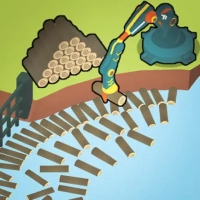
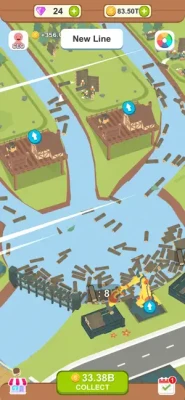
Excavators create waterways around logging areas, workers harvest timber and send logs into the flowing water, and downstream cranes collect the logs for transportation. The timber then reaches processing facilities where it can be transformed into different goods.
The game is built around watching a production chain gradually become larger and more efficient, making it a good fit for players who enjoy idle tycoon, factory management, lumber, and resource-management games.
What Is Aquatic Logging Factory?
Aquatic Logging Factory is an idle lumber-management game developed by Solid Games.
The unusual feature is its water-based transportation system. Rather than relying entirely on conventional roads or conveyor belts, the game uses waterways to move harvested timber downstream.
Your operation develops through several connected stages:
Logging Sites → Waterways → Timber Harvesting → Floating Logs → Cranes → Transportation → Processing Plants → Finished Goods
The more efficiently these stages work together, the more productive your lumber operation becomes.
The game is currently listed as a Casual title on Apple's App Store and as a Simulation/Idle game on Google Play. Google Play also lists it as single-player, offline, stylized, and light-hearted. citeturn0search1
Aquatic Logging Factory Gameplay
The central gameplay loop starts when you unlock logging sites.
Excavators then carve waterways around the forest, creating routes for harvested timber to travel downstream.
Workers cut timber and throw the logs into the flowing streams. The water carries the logs toward downstream collection points.
Once cranes become available, they can lift the logs from the water and prepare them for transportation to processing facilities.
At the processing plants, raw timber is transformed into different goods.
This creates a satisfying production cycle where every new improvement can affect the flow of resources through the entire operation.
Main Features
Waterway-Based Logging
One of the game's defining mechanics is the use of waterways to transport timber.
Logs are harvested in the forest and placed into flowing water, allowing them to travel toward downstream collection points.
This gives the game a distinctive visual identity compared with conventional lumber-management games.
Logging Sites
Unlocking new logging locations expands the area from which your factory can obtain timber.
Each new site can become another source of raw materials for your growing production network.
Excavators
Excavators play an important role in developing the waterways around the forest.
Creating suitable water routes allows harvested logs to move toward the next stage of the operation.
Timber Harvesting
Workers continuously harvest timber from the unlocked logging areas.
Keeping the supply of raw logs flowing is essential because processing facilities depend on a steady supply of materials.
Downstream Cranes
Cranes collect logs after they travel through the waterways.
These collection points connect the forest and waterway system with transportation and processing.
Processing Plants
Raw logs are not the final product.
Processing facilities transform timber into various goods, giving the factory a second stage of production beyond simple harvesting.
Idle Progression
Aquatic Logging Factory follows an idle-game structure, allowing players to develop their operation progressively without requiring constant interaction.
Google Play currently categorizes the game under Simulation and Idle and lists it as an offline game.
Aquatic Logging Factory Strategy Guide
1. Understand the Complete Production Chain
Before spending resources on upgrades, learn how the different sections of the factory connect.
The basic chain is:
Forest → Logging → Waterway → Crane → Transport → Processing → Goods
An improvement at the beginning of the chain is useful only if the later stages can handle the additional production.
For example, increasing timber harvesting while the crane or processing stage remains slow can create a production imbalance.
2. Prioritize Your Current Bottleneck
One of the most useful strategies is to identify the slowest part of your operation.
Ask yourself:
Where are my logs waiting?
If timber is not reaching the water quickly enough, your logging operation needs attention.
If logs are piling up in the waterways, look at downstream collection.
If cranes are collecting timber faster than the processing plants can handle it, improving processing becomes more important.
This approach is more effective than automatically buying every available upgrade.
3. Keep Waterways Flowing
The waterways are effectively the transportation system connecting the forest to your downstream facilities.
A strong timber supply is valuable only when logs can move efficiently through the water network.
Pay attention to whether harvested logs are reaching collection points consistently.
When your operation expands, remember that the waterway network is part of your production infrastructure, not merely decoration.
4. Develop Logging Sites Gradually
Unlocking additional logging locations increases the potential supply of timber.
However, expansion should be matched with sufficient collection and processing capacity.
A useful progression pattern is:
Expand logging → improve transportation → improve collection → increase processing
This helps prevent a situation where you produce more timber than the rest of the factory can handle.
5. Upgrade Cranes When Logs Accumulate
Cranes form an important bridge between the waterways and the factory.
If logs are reaching the downstream area faster than they can be collected, the crane operation may become your bottleneck.
Watch the movement of timber rather than simply looking at upgrade prices.
If logs consistently wait for collection, improving this stage can have a larger effect than increasing production upstream.
6. Don't Forget Processing Plants
New players may naturally focus on logging because it is the first visible source of resources.
But the real objective is to turn raw timber into finished goods.
That means processing capacity deserves attention as your lumber supply increases.
A useful way to think about the factory is:
Raw timber has no value to your operation until the production chain can successfully move and process it.
7. Build a Balanced Production System
Avoid making one section dramatically stronger than everything else.
For example, having extremely high logging production does not help much if your cranes or processing plants cannot keep up.
Try to maintain reasonable balance between:
- Logging
- Waterway transport
- Crane collection
- Transportation
- Processing
- Finished-goods production
A balanced operation generally gives your upgrades a more useful effect.
8. Use Idle Time Efficiently
Because Aquatic Logging Factory is designed around idle progression, your factory can continue working while you are away.
Before leaving the game, check that your production chain is functioning properly.
A useful routine is:
- Collect available earnings.
- Check timber production.
- Look for resource bottlenecks.
- Upgrade the weakest important stage.
- Unlock worthwhile expansion opportunities.
- Leave the factory running.
- Return later and reinvest your earnings.
This turns idle periods into productive development time.
9. Spend Currency Carefully
Don't spend every available resource immediately.
Before purchasing an upgrade, consider whether it will actually improve the current production problem.
If timber production is already much faster than processing, another logging upgrade may not be your most useful purchase.
Instead, improve the stage that is limiting the entire system.
10. Expand Only When the Factory Can Support It
Expansion is an important part of an idle tycoon game, but bigger does not automatically mean more efficient.
When opening a new logging area, consider whether your downstream systems can handle the additional timber.
A good expansion should create additional useful production rather than simply increasing the amount of material waiting for the next machine.
11. Watch the Flow of Logs
Aquatic Logging Factory gives you a very visual way to identify production problems.
Watch the logs.
If they move steadily from the forest toward the cranes, the waterway system is doing its job.
If they frequently accumulate at one location, that area deserves attention.
This makes the game's visual feedback useful for deciding what to upgrade next.
12. Focus on Throughput Instead of Individual Levels
A common mistake in factory games is becoming too focused on the level of a single machine.
Instead, focus on throughput — how much useful material successfully travels through the entire production system.
The goal is not simply:
Higher logging level
The goal is:
More timber successfully converted into finished goods.
That distinction can make your progression much more efficient.
Best Upgrade Strategy
A practical upgrade order is:
Early Game
Focus on establishing reliable timber production and water transportation.
Growing Factory
Improve cranes and collection capacity as more logs begin moving downstream.
Expanding Operation
Increase processing capacity so the factory can handle the additional timber.
Larger Production Network
Balance logging, transportation, collection, and processing rather than concentrating resources on only one stage.
The exact best upgrade will depend on where your current bottleneck is.
Aquatic Logging Factory Tips and Tricks
Tip 1: Watch the logs
The movement of timber can reveal where your production chain is slowing down.
Tip 2: Upgrade bottlenecks first
The slowest important stage usually deserves your attention.
Tip 3: Don't overproduce raw timber
More logging is not always better if downstream systems cannot process the additional material.
Tip 4: Keep cranes productive
Cranes connect the waterway network to transportation and processing.
Tip 5: Expand progressively
New logging areas are most useful when your existing infrastructure can support them.
Tip 6: Improve processing
Finished goods are the ultimate goal, so don't neglect your processing plants.
Tip 7: Use idle time
Prepare your factory before leaving the game so your operation can continue producing.
Tip 8: Look for queues
Logs waiting at any stage are a useful indication of where your next upgrade should go.
How to Make Faster Progress
The fastest way to improve an idle factory is usually not to upgrade everything equally.
Instead, identify the limiting stage.
For example:
Slow logging: improve harvesting.
Logs waiting in the water: examine the downstream flow and collection system.
Logs waiting for cranes: improve crane capacity.
Processed timber waiting for the next stage: improve transportation or processing.
Strong production but weak earnings: examine whether the later stages are keeping up.
This turns the game from simple upgrade clicking into a small production-management puzzle.
Aquatic Logging Factory Progression
Early Progression
The early game introduces the basic relationship between logging sites, waterways, and timber.
Your first objective is to establish a dependable flow of logs.
Mid-Game Progression
As more logging areas and production facilities become available, the factory becomes more interconnected.
At this point, bottleneck management becomes increasingly important.
Later Progression
The larger your operation becomes, the more important it is to balance every stage.
The objective changes from simply unlocking new areas to creating an efficient timber-processing network.
Is Aquatic Logging Factory Easy to Play?
Yes. The game uses a straightforward idle-management structure.
The controls and basic objective are accessible, while the progression comes from deciding how to expand and improve the production chain.
Its calm waterway setting also gives it a more relaxed feel than many traditional factory or resource-management games.
Google Play describes it as stylized and light-hearted, in addition to listing it as an idle, single-player, offline simulation.
Aquatic Logging Factory on iPhone and iPad
The App Store lists Aquatic Logging Factory for iPhone and iPad. It requires iOS 13.0 or later on iPhone and iPadOS 13.0 or later on iPad. The listing also shows support for English and 13 additional languages.
The game is free to download and contains optional in-app purchases.
Ads and In-App Purchases
Aquatic Logging Factory is free to play but includes advertising and optional purchases.
The App Store currently lists No Ads Lite for $4.99 and No Ads Plus for $9.99, along with several Diamond packages ranging from $1.99 to $99.99.
The store reviews also contain comments about advertising and the repetitive nature of upgrading machines, although the current US App Store listing shows a 4.7/5 rating from 763 ratings. These are player opinions rather than objective measurements of the game's quality.
Aquatic Logging Factory Pros and Cons
Pros
- Unique water-based logging concept
- Relaxing idle gameplay
- Timber transportation through waterways
- Excavator and crane mechanics
- Factory-processing progression
- Multiple stages in the production chain
- Easy-to-understand gameplay
- Offline single-player support on Google Play
- Available for iPhone and iPad
Cons
- The upgrade cycle can become repetitive
- Advertising is part of the free-to-play experience
- Players seeking complex real-time strategy may want more depth
- The core gameplay focuses heavily on incremental factory progression
The App Store's current reviews include both positive comments about the graphics and criticisms about repetitive upgrades and advertising.
Aquatic Logging Factory FAQ
What is Aquatic Logging Factory?
Aquatic Logging Factory is an idle simulation game about managing a timber operation. Players unlock logging sites, create waterways, harvest logs, collect them with cranes, transport them, and process timber into goods.
Who developed Aquatic Logging Factory?
The game was developed by Solid Games.
Is Aquatic Logging Factory free?
Yes. The game is free to download, with optional in-app purchases.
Is Aquatic Logging Factory an idle game?
Yes. Google Play describes it as an Idle and Simulation game.
Can you play Aquatic Logging Factory offline?
Google Play currently lists the game as offline and single-player.
What do you do in Aquatic Logging Factory?
You manage a lumber production network. You unlock logging sites, create waterways, harvest timber, move logs downstream, collect them with cranes, and send them to processing plants.
How do you progress faster?
Identify the slowest part of your production chain and upgrade that area first. Keep logging, transportation, crane collection, and processing reasonably balanced.
What is the main strategy in Aquatic Logging Factory?
The main strategy is to maintain a smooth flow of timber from logging sites through waterways and cranes into processing facilities. Avoid creating more raw timber than your downstream systems can handle.
Does Aquatic Logging Factory have ads?
Yes. The App Store listing indicates advertising, and it also offers purchases designed to remove ads.
Does Aquatic Logging Factory have in-app purchases?
Yes. The App Store currently lists No Ads purchases and several Diamond packages.
Is Aquatic Logging Factory available on iPhone?
Yes. The App Store lists it for iPhone and iPad and requires iOS 13 or later.
Final Thoughts
Aquatic Logging Factory gives the idle tycoon formula a distinctive twist by putting waterways at the center of its lumber-production system.
The most satisfying part of the game is watching the complete chain develop: excavators create waterways, workers harvest timber, logs travel downstream, cranes collect them, and processing plants transform the raw material into finished goods.
The best approach is to think of the operation as one connected factory rather than a collection of individual machines. Keep an eye on where logs are accumulating, upgrade the current bottleneck, and expand your logging network when the downstream infrastructure is ready.
For players searching for idle lumber games, logging simulator games, factory management games, idle tycoon games, timber games, resource management games, and casual simulation games, Aquatic Logging Factory offers a simple production-focused experience with a distinctive water-transport mechanic.
Rate the Game
User Reviews















Popular Games



















 Android
 iOS
 Windows
 Xbox