
Latest Version
September 09, 2024
SayGames Ltd
Strategy
0
com.kadka.battle.draw
Report a Problem
More About :game
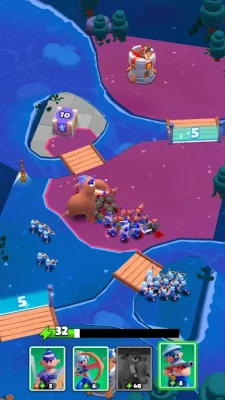
The game features infantry, archers, cannons, robots, ninjas, and other specialized units. Every battle challenges you to decide where to deploy your army, when to reinforce an attack, and how to respond to your opponent's strategy. Victories also help unlock new towers, territories, units, and battle-card progression.
What Is Draw Arena: Battle Tactics?
Draw Arena: Battle Tactics is a mobile strategy and tower-defense game built around competitive battles. The distinctive feature is its drawing-based deployment system: you decide where your units enter the battlefield instead of relying entirely on automatic placement.
The current Google Play description presents the game as real-time PvP, with opponents from around the world, multiple environments, different unit types, tower defense, battle cards, and progressive unlocking.
The result is a game where placement can matter just as much as unit strength.
Game Information
Game: Draw Arena: Battle Tactics
Earlier/alternate name: Battle Draw: Clash of Towers!
Package: com.kadka.battle.draw
Developer/Publisher: SayGames Ltd
Genre: Strategy, Tower Defense, Casual
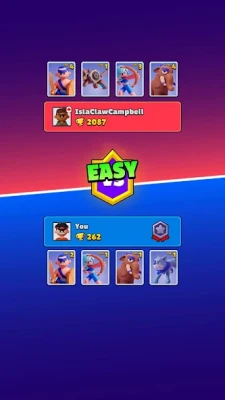
Main Mode: Competitive PvP
Platforms: Android and Windows through Google Play
Monetization: Free-to-play with advertisements and in-app purchases
Rating: Everyone 10+
Downloads: 1M+
Google Play rating: About 4.3 stars
Core mechanic: Draw and position armies
Main objective: Defend your tower and destroy the enemy fortress
Progression: Units, battle cards, towers and territories
The current Google Play listing was updated August 17, 2026.
How Draw Arena Works
A typical battle revolves around two competing objectives:
Defend your tower.
and
Break through the opponent's defenses.
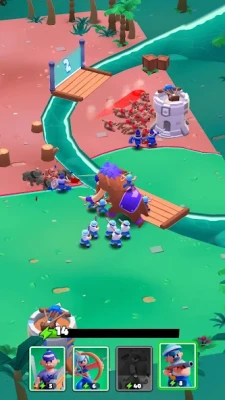
You deploy your army onto the battlefield by drawing or placing units in strategic positions. Once the battle develops, you need to evaluate what your opponent is doing and adapt your deployment.
The game therefore rewards players who can combine:
Good positioning
Unit knowledge
Timing
Pressure
Defensive awareness
Counter-attacks
Battlefield control
Simply producing more troops is not always enough.
The Drawing Mechanic
The drawing system is the defining feature of Draw Arena.
Rather than treating deployment as a simple button press, you have control over where your forces are positioned.
This gives you an important advantage: you can shape the battle before your army reaches the enemy.
Why Placement Matters
A unit placed in the correct location can:
Attack sooner
Avoid unnecessary damage
Support another unit
Protect a vulnerable flank
Pressure an enemy tower
Create a stronger push
Force the opponent to react
A poorly positioned unit can become ineffective even when it is individually powerful.
Understanding the Battlefield
Before deploying your army, quickly identify:
Your tower
The enemy tower
Main attack routes
Open areas
Defensive positions
Likely approach routes
Areas where ranged units can operate safely
Do not immediately fill the battlefield with troops.
Take a moment to understand how the terrain affects movement and combat.
Infantry Strategy
Infantry is one of the most straightforward unit categories.
They are useful for creating a frontline and absorbing pressure while other units operate behind them.
Best Uses for Infantry
Use infantry to:
Establish a frontline
Protect ranged units
Pressure weak areas
Occupy space
Support an offensive push
Slow down enemy advances
A common mistake is sending infantry too far ahead without support.
A stronger formation normally keeps the frontline close enough to receive ranged or specialized support.
Archer Strategy
Archers provide ranged pressure and are especially useful when protected by tougher frontline units.
Instead of placing them directly in front, position them behind units capable of absorbing incoming attacks.
Archer Formation
A simple formation is:
Frontline → Infantry
Second line → Archers
This allows infantry to engage the opponent while archers continue dealing damage from behind.
Do not expose your entire ranged force to an enemy rush.
Cannon and Heavy Artillery Strategy
Cannons are valuable because they provide heavy firepower and can influence areas where several enemy units are grouped.
However, powerful ranged units should not be treated as frontline soldiers.
The ideal approach is to create enough space around artillery so that it can continue attacking.
Cannon Rule
Protect expensive or powerful ranged units with cheaper frontline troops.
If your cannon is destroyed before it has time to contribute, its theoretical strength does not matter.
Robot Units
Robots provide another layer of tactical variety as your army develops.
Use them according to their specific battlefield role rather than automatically replacing every other unit.
Robots can be particularly useful when you need to change the composition of your army to counter an opponent's repeated strategy.
Ninja Units
Ninjas are among the more specialized units mentioned in the current game description.
Their value comes from giving your army another tactical option beyond traditional infantry and ranged troops.
Rather than using ninjas simply because they are unlocked, consider whether they solve a specific problem in your current formation.
Building a Balanced Army
A good army should normally contain different battlefield roles.
Think in terms of:
Frontline: Units that can survive direct engagement
Ranged damage: Units that attack from safer positions
Heavy damage: Units capable of threatening dense formations
Specialists: Units that change how you approach particular opponents
Avoid building an army where every unit performs the same function.
A balanced composition gives you more ways to respond when the opponent changes strategy.
The Best Beginner Formation
For new players, a simple formation is usually easier to control than an extremely complicated deployment.
Start with:
Frontline → Infantry
Behind frontline → Archers
Rear → Cannon or other ranged support
Then add specialized units as you understand their roles.
This gives your army a basic defensive structure while still allowing offensive pressure.
How to Attack an Enemy Tower
Do not send every unit directly toward the enemy tower.
First determine where the opponent's army is concentrated.
If their defense is heavily committed to one side, you may be able to create pressure elsewhere.
Strong Attack Sequence
Establish a safe frontline.
Add ranged support.
Observe the opponent's defensive response.
Reinforce the weaker side.
Continue pressure where the enemy is struggling.
Protect your own tower while attacking.
Commit additional units when you see an opening.
The objective is not necessarily to attack everywhere.
The objective is to make the opponent defend in the wrong place.
How to Defend Your Tower
Defensive play is just as important as attacking.
If your opponent begins building a large offensive force, do not panic and deploy everything immediately.
Instead:
Identify the strongest incoming threat.
Reinforce the threatened area.
Keep ranged units protected.
Maintain enough forces to launch a counterattack.
Watch the opposite side of the battlefield.
A strong defense can become an offensive opportunity.
The Counter-Attack Strategy
One of the best ways to punish an aggressive opponent is to defend efficiently and counterattack after their main force has been committed.
For example:
The enemy creates a large push.
You defend using a smaller but well-positioned formation.
Their attack loses momentum.
Their army becomes weaker.
You deploy fresh units.
Your counterattack reaches their tower while their army is still recovering.
This is especially effective against players who constantly attack without maintaining defensive reserves.
Do Not Overcommit
One of the biggest strategic mistakes is spending your entire deployment potential on one attack.
A massive push can look impressive, but if it fails, you may have nothing left to defend your tower.
Try to maintain a reserve whenever possible.
This gives you flexibility if the opponent suddenly changes direction.
Watch Your Opponent
Draw Arena is not just about building your own army.
You should constantly study what the other player is doing.
Look for:
Repeated unit combinations
Heavy use of one lane
Weak defensive areas
Excessive ranged units
Aggressive early pushes
Slow defensive play
Attempts to overwhelm one side
Once you recognize the opponent's pattern, adjust your deployment.
How to Counter Ranged Armies
If an opponent relies heavily on ranged units, avoid allowing your frontline to approach them without support.
Use your own formation to:
Close distance safely
Protect advancing troops
Attack their vulnerable support units
Pressure multiple areas
The goal is to prevent the opponent's ranged units from continuously firing without being threatened.
How to Counter Heavy Frontlines
If the opponent creates a large frontline, do not simply mirror it.
Instead, consider using ranged damage and positioning to weaken the frontline before committing to a direct confrontation.
A large number of tough units can become less effective if they are forced to advance into concentrated ranged fire.
How to Handle Aggressive Players
Aggressive players often reveal their strategy early.
If an opponent attacks immediately:
Do not panic.
Strengthen your defense.
Protect your ranged units.
Let their attack lose momentum.
Identify where their army is weakest.
Counterattack when their main force has been committed.
Aggression becomes dangerous when you react emotionally.
How to Handle Defensive Players
A defensive opponent may attempt to make you attack into a strong formation.
Do not continuously throw units at the same position.
Instead:
Probe different areas.
Test their defensive reaction.
Shift your deployment.
Create pressure on another route.
Force them to move their strongest units.
Your objective is to make their defense inefficient.
Tower Defense Strategy
Draw Arena is not only about attacking.
The game also allows you to build up your own tower defenses as progression continues.
Treat your tower as part of your overall strategy rather than something that can be ignored while you attack.
A successful offensive player still needs a reliable defensive foundation.
Battle Cards and Progression
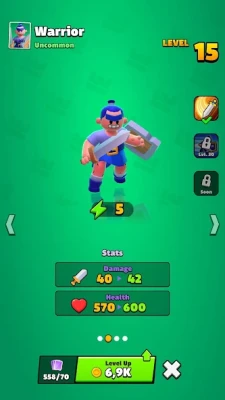
Victories can provide battle cards that help strengthen fighters and contribute to progression. The game also uses unlockable towers, territories and additional units to expand the player's options.
This creates a progression loop:
Battle → Win → Collect rewards/cards → Improve army → Unlock content → Enter stronger battles
As your collection expands, the important question becomes which units work best together rather than simply which unit has the highest individual power.
How to Spend Upgrades Wisely
Do not spread every upgrade equally across every available unit.
Choose a core group that you actually understand and use regularly.
For example:
One dependable frontline
One reliable ranged unit
One heavy-damage option
One specialist
Once this core is strong, expand into additional units.
This prevents your army from becoming broad but underpowered.
Terrain and Locations
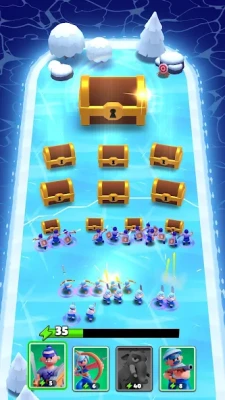
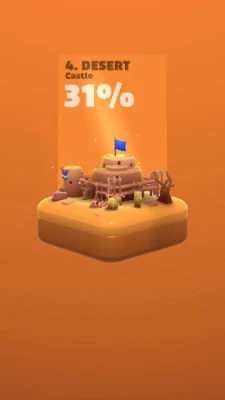
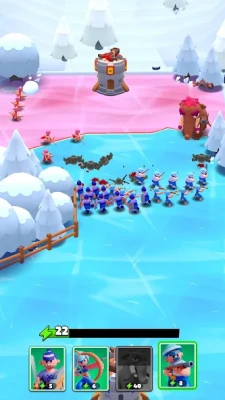
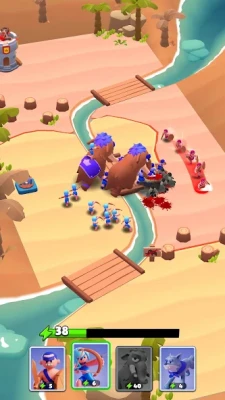
Draw Arena includes multiple environments, including forests, beaches, frozen landscapes and deserts.
Different environments give the game visual variety and require you to pay attention to the battlefield rather than blindly repeating one deployment pattern.
When entering a new location, spend your first moments studying the available space before committing your strongest units.
Advanced Strategy: Layered Deployment
Instead of drawing a single large formation, think in layers.
Layer 1 – Frontline
Absorb pressure and establish battlefield control.
Layer 2 – Damage
Deploy archers or other ranged attackers behind the frontline.
Layer 3 – Heavy Support
Place powerful ranged or specialist units where they can continue attacking safely.
Layer 4 – Reinforcement
Keep enough flexibility to respond to what the opponent does next.
This approach is safer than placing every unit in one dense cluster.
Advanced Strategy: Pressure the Weak Side
If the opponent consistently protects one side of the battlefield, do not keep attacking that same area.
Probe the weaker side.
Once you find an area where their defense is slower or thinner, increase pressure there.
This forces the opponent to make decisions instead of allowing them to execute their preferred strategy.
Advanced Strategy: Create False Pressure
You can also use a smaller deployment to make your opponent believe that a major attack is coming from one direction.
If they react by moving their strongest units there, you can redirect your main force elsewhere.
The drawing mechanic makes this kind of positional deception particularly useful.
Common Mistakes
1. Deploying Everything Immediately
This removes your ability to respond later.
2. Ignoring Defense
Destroying the enemy tower does not help if your own tower falls first.
3. Putting Archers on the Frontline
Ranged units need protection.
4. Using One Unit Type Exclusively
A specialized army can become predictable.
5. Attacking the Strongest Enemy Position
Look for weak points instead.
6. Forgetting to Watch the Opponent
Your strategy must adapt to theirs.
7. Overvaluing Individual Unit Strength
A powerful unit in a bad position can be less useful than several properly coordinated units.
8. Spending Upgrades Everywhere
Build a reliable core before expanding your investment.
Beginner Tips
Study the battlefield before deploying.
Protect your tower at all times.
Build a frontline before exposing ranged units.
Do not send every unit into one lane.
Watch how your opponent deploys.
Save flexibility for counterattacks.
Use different unit roles together.
Upgrade units you actually use.
Experiment with placement rather than repeating one formation.
Treat every PvP match as an opportunity to learn the opponent's patterns.
Intermediate Tips
Once you understand the basics, focus on:
Creating layered formations
Switching attack lanes
Counterattacking after enemy overcommitment
Protecting ranged damage
Identifying predictable opponents
Maintaining defensive reserves
Using specialized units to solve specific problems
Improving your deployment timing
Advanced PvP Strategy
At higher skill levels, the battle becomes less about individual units and more about tempo.
Tempo means controlling when and where the opponent is forced to react.
A strong player tries to:
Force the opponent to defend.
Observe which units they use.
Identify the resulting weakness.
Change the attack direction.
Maintain enough defense to prevent a counterattack.
Increase pressure once the opponent's formation becomes inefficient.
This creates a cycle where your opponent is constantly reacting instead of executing their own plan.
Controls
Draw Arena is built around touch-based drawing and placement.
The controls are intentionally accessible, while the strategic depth comes from deciding where to deploy units and how to adapt after the battle begins.
That makes the game easy to understand for casual players but gives experienced players room to experiment with positioning.
Difficulty
The basic controls are easy to learn, but competitive matches become more demanding as opponents become better at positioning and adapting.
The difficulty is therefore primarily strategic rather than mechanical.
Players who understand unit roles, spacing, timing and counterattacks will generally have a major advantage over players who simply deploy units as quickly as possible.
Ads and In-App Purchases
The current Google Play listing states that Draw Arena contains advertisements and in-app purchases.
Player feedback has also criticized advertising frequency. One Google Play review specifically complained that advertisements could take longer than the battles themselves.
This is worth considering if you prefer uninterrupted competitive sessions.
Player Feedback
The current Google Play listing shows approximately 4.3 stars from more than 11,000 reviews, with more than 1 million downloads.
The strongest positive aspect is the core idea: drawing and positioning an army gives the game a more interactive feel than conventional automated tower-defense games.
The major criticism is monetization, particularly advertising. Some users have also reported technical problems or concerns around progression and competitive balance.
Graphics and Atmosphere
Draw Arena uses a colorful, stylized battlefield presentation rather than a realistic military aesthetic.
The environments range from forests and beaches to icy landscapes and deserts, giving battles a changing visual backdrop.
The visual style supports the game's casual strategy identity while keeping the battlefield easy to read.
Game Modes and Availability
The current Google Play listing describes Draw Arena primarily around competitive multiplayer battles, while the store metadata also identifies strategy, tower defense, casual, multiplayer, competitive multiplayer and single-player classifications. It is currently listed for Android and Windows.
The central experience remains the PvP tower battle in which players deploy armies, defend their own structure and attempt to destroy the opponent's fortress.
Pros and Cons
Pros
Creative drawing-based army deployment
Real-time competitive battles
Easy-to-understand controls
Strong tactical positioning element
Multiple unit types
Infantry, archers, cannons, robots and ninjas
Tower defense and offensive gameplay combined
Multiple environments
Battle-card progression
Unlockable towers and territories
Regular updates
Available on Android and Windows
Cons
Advertising can be intrusive
In-app purchases may affect the progression experience
Matches can feel repetitive over time
Some players have reported technical issues
Competitive balance may vary depending on progression
The drawing mechanic takes practice to use effectively
Is Draw Arena: Battle Tactics Worth Playing?
Draw Arena is a good choice for players who enjoy casual strategy games but want more direct control than traditional tower defense provides.
Its strongest idea is the drawing mechanic. Instead of simply watching an army move along a predetermined route, you influence the battlefield by deciding where your troops are placed.
The game is especially appealing if you enjoy experimenting with formations and countering other players.
However, the advertising model is a legitimate downside, and players who dislike frequent interruptions may find the experience frustrating.
Final Verdict
Draw Arena: Battle Tactics turns a familiar tower-defense formula into a more interactive battlefield strategy game.
Its key lesson is simple:
Where you place a unit can be just as important as which unit you choose.
The best strategy is to create a balanced army, protect your ranged units, maintain a strong frontline, watch your opponent carefully and avoid committing everything to a single attack.
For beginners, focus on formation and defense. For experienced players, concentrate on tempo, deception, counterattacks and exploiting weak positions.
With its combination of drawing mechanics, tower defense, unit collection and competitive battles, Draw Arena offers a distinctive casual strategy experience for players who enjoy tactical mobile games.
Frequently Asked Questions
What is Draw Arena: Battle Tactics?
Draw Arena: Battle Tactics is a strategy and tower-defense game centered around drawing and positioning armies in competitive battles.
What was Battle Draw: Clash of Towers?
Battle Draw: Clash of Towers! was an earlier name associated with the same package, com.kadka.battle.draw. The current Google Play listing uses the name Draw Arena: Battle Tactics.
Who developed Draw Arena?
The current Google Play listing identifies SayGames Ltd as the developer and publisher.
Is Draw Arena a PvP game?
Yes. The game is designed around real-time competitive battles against other players.
What units are available?
The game features infantry, archers, cannons, robots, ninjas and other specialized units as progression continues.
How do you win battles?
You need to protect your own tower while using strategically positioned units to destroy the opponent's fortress.
Does unit placement matter?
Yes. Strategic placement is one of the game's central mechanics.
Does Draw Arena have tower defense?
Yes. You defend your own tower while simultaneously attacking the enemy's fortress.
Can you unlock new units?
Yes. Progression includes new soldiers and equipment, along with towers and territories.
Does Draw Arena have battle cards?
Yes. Victories and progression involve collecting battle cards that can help level up and enhance fighters.
Does Draw Arena contain ads?
Yes. The current Google Play listing states that it contains advertisements and in-app purchases.
Can you play Draw Arena on Windows?
The current Google Play listing indicates Android and Windows availability.
Is Draw Arena difficult?
The controls are easy to learn, but winning consistently requires good positioning, timing and the ability to adapt to another player's strategy.
Rate the Game
User Reviews



Popular Games



















 Android
 iOS
 Windows
 Xbox