





Latest Version
October 31, 2024
Studio Zero Incorporated
Role Playing
iOS
0
Report a Problem
More About :game
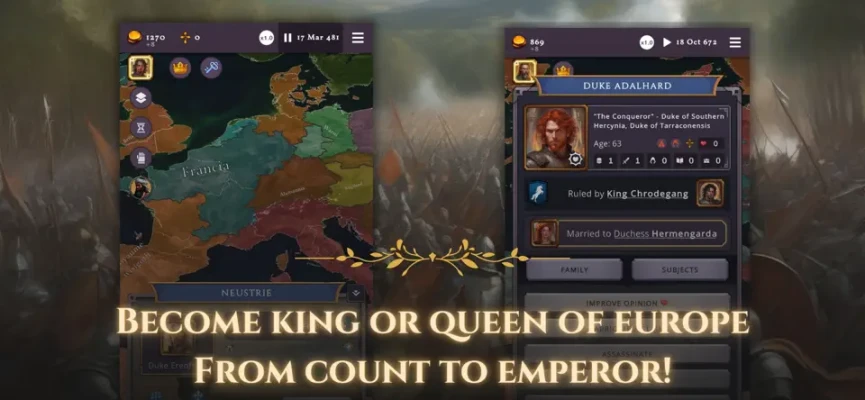
Clovis Medieval Grand Strategy puts you in control of a medieval ruler and gives you the freedom to decide how your kingdom develops.
You aren't simply commanding armies from a map. Your character has a personal life, family, relationships, ambitions, enemies, political responsibilities, and a legacy to protect.
You can conquer neighboring territories, negotiate with foreign rulers, arrange marriages, build castles, raise armies, pass laws, research technologies, organize expeditions, use spies, participate in religious affairs, and manipulate political events.
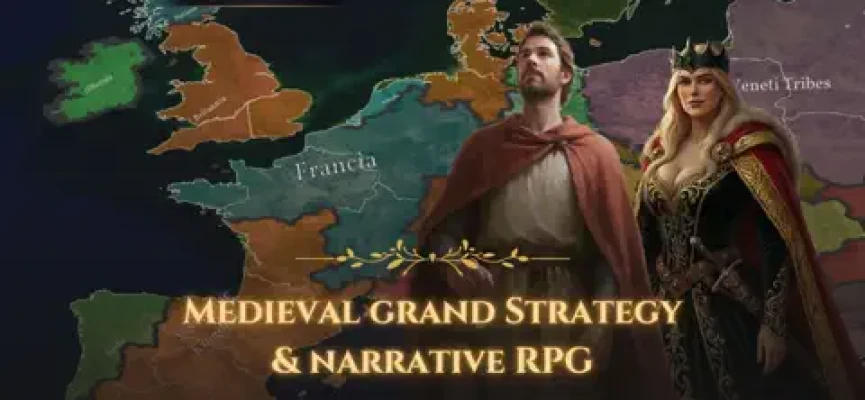
The result is a combination of grand strategy, medieval life simulation, RPG progression, dynasty management, and 4X warfare.
The World of Clovis
The game uses medieval Europe and its surrounding regions as the main playground for your ambitions.
Depending on the scenario and character you choose, you can experience the world through the perspective of different cultures and rulers.
The App Store specifically mentions playing as a Roman emperor, Ostrogothic Dux Bellorum, or Clovis, the first king of France, while the customization system allows players to create their own medieval stories.
Recent updates have also expanded the playable world and historical possibilities, including scenarios involving Jerusalem, Saladin, Viking raids, Iceland, Byzantine politics, and an expanded Europe-and-Asia map.
Grand Strategy Gameplay
At its core, Clovis is about making long-term decisions.
Every kingdom needs territory, resources, military strength, political stability, and capable leadership.
You must decide when to expand and when to consolidate your power.
A successful ruler might:
- Expand through warfare
- Build alliances
- Arrange strategic marriages
- Develop technology
- Strengthen castles
- Pass laws
- Manage vassals
- Develop trade
- Use espionage
- Participate in religious affairs
- Organize expeditions
- Build a dynasty
There is no single route to victory.
Medieval Warfare
War is one of the central pillars of Clovis.
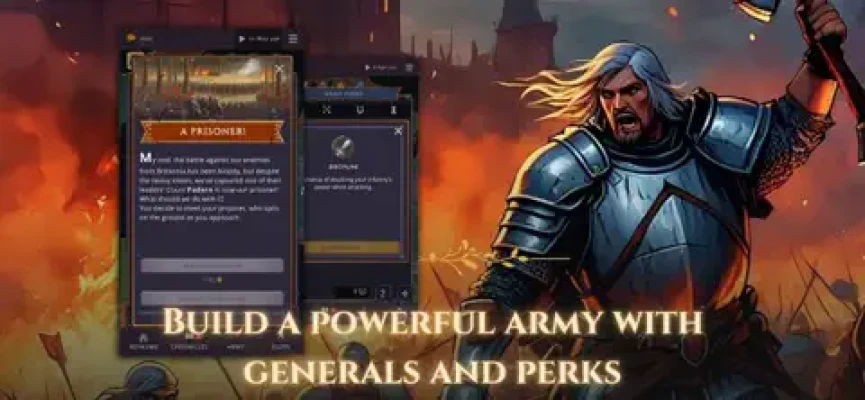
You can raise armies, appoint generals, attack rival kingdoms, defend your territory, and use strategic decisions to influence battles.
The game has also received updates improving tactical battles, including a system featuring two rounds and additional battle factors.
Recent updates have also introduced or improved:
- Naval warfare
- Viking raids
- Castle expansions
- Army perks
- Crusades
- AI wars
- Generals
- Fortifications
These additions make warfare an important part of the broader kingdom-management system.
Naval Invasions
Naval warfare is a newer addition to Clovis.
The developer describes the navy feature as a way to conduct naval invasions and expand the strategic possibilities of warfare.
This is particularly important for kingdoms that want to project military power beyond their immediate borders.
Build Castles and Fortresses
Defensive infrastructure matters as much as offensive power.
Players can build castles and strengthen their fortresses, with later updates adding castle expansions designed to turn strongholds into more powerful defensive positions.
This creates another strategic choice:
Expand your borders or strengthen the territory you already control?
Dynasty Building
One of Clovis's defining features is its focus on family and legacy.
Your ruler isn't necessarily the end of the story.
You can marry, have children, form political relationships, and develop a dynasty that continues beyond the life of a single character.
The game added a dedicated dynasty system in version 2.0, allowing players to establish dynasties through Legacy Points and create family-related events.
Marriage and Political Alliances
Marriage can be more than a personal relationship.
A carefully chosen marriage can connect your kingdom with powerful allies and strengthen your political position.
The official description specifically describes marrying into another powerful family and passing Dynasty Skills to future children.
This makes family management part of your wider political strategy.
Plots and Intrigue
Not every conflict has to be fought on the battlefield.
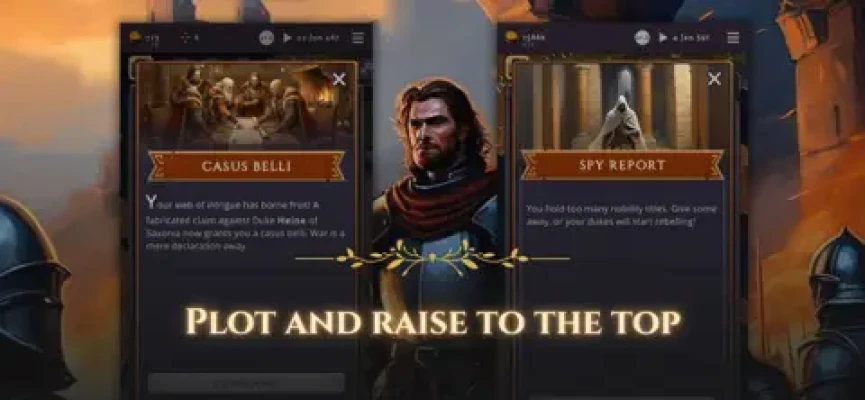
Clovis includes plots and political manipulation that allow rulers to deal with enemies through intrigue.
You may need to identify traitors, manage relationships, investigate conspiracies, or use a spy network.
Recent updates have added improvements to the spy network and interactions involving traitors.
Spy Networks
Espionage gives ambitious rulers another way to influence the political landscape.
A spy network can help you gather information and deal with potential threats without immediately declaring war.
This is especially useful when military action would be too expensive or politically dangerous.
Diplomacy
Diplomacy plays a major role in the game.
You can interact with foreign kingdoms, form relationships, negotiate trade arrangements, and deal with ambassadors.
A recent update added foreign ambassadors who can arrive at court to negotiate trade agreements.
This makes diplomatic relationships more dynamic than simply choosing whether to declare war.
Trade and Economy
A successful kingdom needs more than soldiers.
Trade allows you to develop the economic side of your empire.
The game's newer trade system includes luxury goods and additional requirements for growth, adding another layer of economic decision-making to the late game.
Seasonal droughts can also affect the prices of commodities such as food and wine, creating economic consequences from environmental events.
Laws and Politics
As a ruler, you can influence the laws of your kingdom.
The game has received substantial improvements to its law system, including political support and voting mechanics.
The Senate update introduced elected senators for Roman characters, while members of a voting assembly can influence whether laws are passed. Gold can also be used to influence political outcomes.
This gives the game a political dimension beyond military conquest.
Religion
Religion is another important component of the medieval world.
The game includes religious interactions, conversion mechanics, religious orders, and historical religious events.
Later updates expanded religious systems and introduced additional cultures and religions in the larger Europe-and-Asia map.
Technology Research
Technological development allows your kingdom to improve over time.
Researching new technologies can unlock additional capabilities and influence how your kingdom handles warfare, politics, economy, and other aspects of medieval life.
Technology therefore forms an important part of long-term planning.
Procedurally Generated Events
One of the most interesting aspects of Clovis is its event system.
Your story isn't completely predetermined.
Procedurally generated events can create unexpected situations that force you to make decisions.
You might encounter:
- Bandits
- Tournaments
- Banquets
- Political conflicts
- Treason
- Religious events
- Diplomatic situations
- Economic problems
- Personal relationships
- Military incidents
The developer emphasizes that these events can create different possibilities during each playthrough.
Medieval Life Simulation
Unlike many strategy games that focus exclusively on territory, Clovis also simulates the personal life of your ruler.
Your character has relationships, family, health, ambitions, enemies, and a developing legacy.
That means a ruler can experience success and failure both on the battlefield and inside the royal court.
Character Creation
Clovis offers substantial customization.
The developer describes the game as allowing players to create their own medieval story, including custom rulers and alternative historical scenarios.
You can take on famous historical roles or create a character that fits your own preferred style of play.
Historical Characters
The game includes characters inspired by real history alongside fictional and legendary figures.
Recent updates have added figures such as Richard the Lionheart, King Baldwin IV, Saladin-related scenarios, Irene of Athens, and other historical or legendary rulers.
This mixture of historical figures and player-created stories gives the game considerable flexibility.
Scenario Editor
The scenario editor is one of the game's customization features.
It allows players to create their own scenarios and experiment with different historical or alternate-history situations.
This adds considerable replay value for players who enjoy creating unusual medieval worlds.
Campaign Mode
Clovis now includes a dedicated campaign following the first major story after the tutorial.
The current App Store listing describes the first campaign as following Aurelius, Clothilde, and Regimius as the medieval story begins.
This gives newcomers a more structured way to enter the game's larger sandbox.
Online Clans
Although the game focuses heavily on solo strategy, it also includes online meta-game features.
Online clans have received improvements, including dedicated clan pages and recurring elections for kings.
This adds a social layer for players who want to participate in a community beyond their individual kingdom.
Leaderboards and Achievements
Clovis includes Game Center support with leaderboards and achievements.
These provide additional goals for players who want to measure their accomplishments or complete challenges beyond simply conquering the map.
How to Play Clovis
1. Choose Your Ruler
Start with an existing historical character or create your own medieval ruler.
2. Establish Your Kingdom
Learn your territory, resources, military strength, relationships, and political position.
3. Develop Your Economy
Use trade, resources, and other economic systems to strengthen your kingdom.
4. Build Your Military
Raise levies, appoint generals, strengthen castles, and prepare for war.
5. Use Diplomacy
Build alliances and negotiate with other rulers before reaching for your sword.
6. Develop Your Dynasty
Marry strategically, have children, and establish a lasting family legacy.
7. Manage Your Court
Deal with advisors, nobles, ambassadors, rivals, and political events.
8. Expand Your Territory
Conquer neighboring lands or use diplomacy and other methods to increase your influence.
9. Handle Random Events
Make decisions when unexpected events alter the direction of your story.
10. Build Your Legacy
Your ultimate goal is to leave behind a kingdom and dynasty worthy of remembrance.
Beginner's Guide
Clovis can initially feel overwhelming because it combines several genres at once.
New players should avoid trying to master every system immediately.
Start by learning these five fundamentals:
Economy → Diplomacy → Military → Family → Technology
Don't declare wars simply because a neighboring kingdom looks vulnerable.
First consider whether your economy can support the conflict, whether your allies will help, and whether your kingdom is politically stable.
Marriage can also be an extremely useful diplomatic tool.
Most importantly, remember that Clovis is designed around stories rather than a single perfect strategy.
Strategy & Tips
Strengthen Before Expanding
Conquering territory is exciting, but an unstable kingdom can collapse after rapid expansion.
Use Marriage Strategically
A good marriage can provide political advantages and strengthen your dynasty.
Keep an Eye on Your Vassals
Powerful nobles can become valuable allies or serious threats.
Don't Ignore Diplomacy
Not every problem needs an army.
Develop Your Economy
Military expansion requires financial support.
Strengthen Defensive Positions
Castles and fortifications can become extremely valuable when your kingdom is under attack.
Use Spies Carefully
Information can be more valuable than brute force when dealing with conspiracies.
Think About Succession
Your character's death doesn't necessarily end the story. Prepare your family and dynasty for the future.
Read Your Events
Random events can create opportunities as well as disasters.
Advanced Strategy
Experienced players should think several generations ahead.
A powerful strategy is to combine:
Marriage + Diplomacy + Economy + Technology + Military + Dynasty
For example, you might marry into a powerful neighboring family, establish a trade relationship, improve your technology, strengthen your castles, and wait until your rival becomes politically isolated before launching a campaign.
This approach can be more effective than continuously fighting wars.
Game Progression
Clovis has multiple layers of progression.
Character Progression
Your ruler develops through skills, relationships, events, and achievements.
Kingdom Progression
Your territory, technology, economy, laws, military, and infrastructure develop over time.
Dynasty Progression
Your family can continue your legacy across generations.
Legacy Progression
Legacy Points and dynasty systems give long-term meaning to the actions of individual rulers.
Meta Progression
Cross-save artifacts, seasonal scenarios, legendary characters, leaderboards, clans, and other features provide additional goals outside an individual campaign.
Game Modes
Clovis provides several ways to experience its medieval sandbox:
- Grand strategy campaigns
- Custom scenarios
- Scenario editor
- Peaceful Mode
- Historical starting points
- Seasonal scenarios
- Online clans
- King of the Mountain
- Solo medieval life simulation
- Dynasty-focused gameplay
The exact availability of some scenarios and content can depend on the game's current version or optional content.
Navy and Naval Warfare
Naval gameplay expands the strategic map beyond traditional land warfare.
Players can use naval forces to support invasions and create new military possibilities.
This is particularly valuable for kingdoms separated by water or rulers seeking to expand their strategic reach.
Viking Raids and Iceland
A Nordic-themed update introduced Viking raids and the colonization of Iceland.
The Echoes of the North DLC adds additional Viking-themed content, including portraits, blazons, gifts, a secret order, and a new branch of magic.
The Senate
The Senate system is particularly interesting for players who enjoy political simulation.
Roman characters can participate in a political structure where senators are elected and laws can be voted on.
This turns internal politics into an active gameplay system rather than simply background flavor.
Court Physician
A recent update added the Court Physician, allowing players to address injuries and health-related situations.
The same update added foreign ambassadors and seasonal drought effects, making court life and the economy more dynamic.
Trade Ambassadors
Foreign ambassadors can now arrive at court and negotiate trade agreements.
This gives diplomacy more depth and makes international relations feel more active.
Forge System
The Forge introduced another economic and crafting activity.
Players can craft items, earn money, and develop their character as a blacksmith.
Magic and Fantasy Content
Although Clovis is strongly inspired by medieval history, it isn't restricted to strict historical simulation.
The game includes supernatural content through features such as witchcraft and optional fantasy-themed DLC.
The Ancient Ones DLC, for example, introduces Cthulhu-inspired content, while witchcraft allows characters to use supernatural abilities.
Difficulty
Clovis is best described as a moderate-to-complex strategy game.
The individual actions aren't necessarily difficult, but there are many interconnected systems to understand.
Players familiar with grand strategy games will probably adapt faster, while newcomers may need time to learn diplomacy, succession, laws, warfare, relationships, and economic management.
The App Store reviews also reflect this complexity: one player praised the game but felt that some relationship and political systems could be easier to understand.
Player Experience
The current US App Store listing shows 4.7 out of 5 stars from 422 ratings, which indicates a strong overall reception among the available reviewers.
Positive reviews frequently praise the game's combination of strategy, role-playing, combat, atmosphere, and historical setting.
Some players, however, have requested deeper systems for recognizing a ruler's achievements, clearer political relationships, and additional map or kingdom depth. These are individual player opinions rather than universal shortcomings.
Pros & Cons
Pros
- Deep medieval grand strategy
- RPG elements
- Dynasty management
- Character customization
- Historical characters
- Procedurally generated events
- Diplomacy
- Warfare
- Naval invasions
- Trade
- Religion
- Technology
- Laws and politics
- Spy networks
- Castle development
- Scenario editor
- Campaign mode
- Online clans
- Leaderboards
- Achievements
- Offline gameplay
- No conventional ad-heavy timer system
- Strong player rating
Cons
- Large number of systems can overwhelm beginners
- Some mechanics require learning before their value becomes clear
- Optional DLC and in-app purchases
- Some players want deeper relationship and political feedback
- The game may feel complex for players who prefer simple strategy games
Monetization
Clovis is free to download and includes optional in-app purchases.
The current US App Store listing includes purchases such as:
- Excalibur Subscription
- Character Boosters
- God Mode
- The Romance DLC
- The Royal Hunt DLC
- Envoys from the East DLC
- Echoes of the North DLC
- The Ancient Ones DLC
- Diamond bundles
The listed prices range from $1.49 to $9.99 for the examples shown on the current listing.
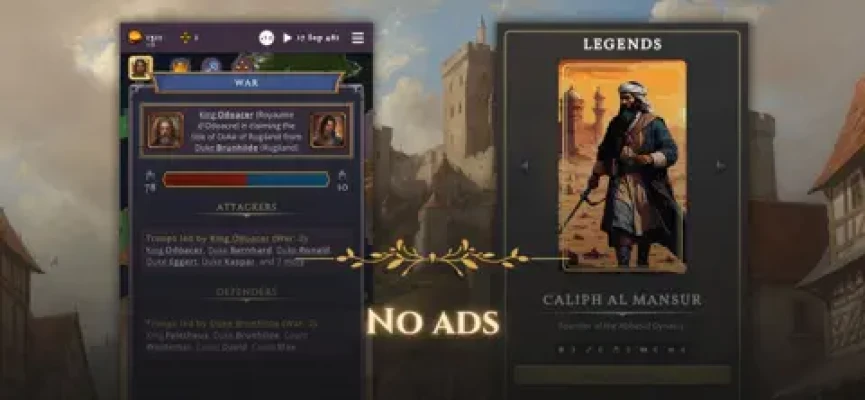
The developer's own description emphasizes an experience without the traditional constant advertising and timer-heavy structure associated with many mobile free-to-play strategy games.
Recent Updates
Clovis is actively receiving updates.
The current App Store listing shows version 2.5.3 and describes a major diplomatic update featuring:
- Court Physician
- Foreign ambassadors
- Trade negotiations
- Seasonal droughts
- Changes to food and wine prices
- Chronicle filtering
- Character history
- Improvements to legends
- Roman culture
- Spy networks
- Family inheritance
- AI wars
The same listing identifies version 2.4.40 as adding the first campaign, a new 1186 starting point involving Jerusalem and Saladin, Spanish culture, and other improvements.
Earlier updates introduced the Senate, Viking raids, expanded trade, dynasties, the Forge, expanded maps, witchcraft, and numerous other systems.
Technical Details
Game: Clovis Medieval Grand Strategy
Developer: Studio Zero Incorporated
Category: Strategy
Genres: 4X, War Simulation, Life Simulation, RPG
Platform: iPhone and iPad
Price: Free
In-App Purchases: Yes
Current Listed Version: 2.5.3
App Size: Approximately 265 MB
Age Rating: 13+
Language: English
iPhone Requirement: iOS 15.0 or later
iPad Requirement: iPadOS 15.0 or later
Mac: macOS 12.0 or later with Apple M1 chip or later
Apple Vision: visionOS 1.0 or later
Game Center: Yes
Achievements: Yes
Leaderboards: Yes
These details are based on the current US App Store listing.
Is Clovis an Offline Game?
Yes. The developer specifically describes Clovis as offering hours of offline gameplay. Some social and meta-game features naturally require connectivity, but the core medieval strategy experience is designed to work offline.
Is Clovis a Grand Strategy Game?
Yes. Grand strategy is one of the game's defining genres. Players manage kingdoms, armies, diplomacy, technology, laws, religion, economy, family, and territorial expansion.
Is Clovis Like Crusader Kings?
Clovis has similarities to the Crusader Kings style of grand strategy because it combines medieval politics, dynasty management, character relationships, warfare, marriage, intrigue, and territorial expansion.
However, Clovis is its own mobile game with a different presentation, systems, scale, and progression structure.
Can You Play as a Roman Emperor?
Yes. The developer specifically mentions the ability to play as a Roman emperor.
Can You Play as Clovis?
Yes. Clovis himself is one of the historical rulers available to players.
Can You Create Your Own Character?
Yes. The game emphasizes customization and lets players create their own medieval stories.
Can You Get Married?
Yes. Marriage is an important part of the dynasty and political systems.
Can You Have Children?
Yes. Family and succession are important parts of the dynasty system.
Can You Build a Dynasty?
Yes. The dedicated dynasty system allows players to establish a lasting family legacy.
Can You Conquer Europe?
Territorial conquest is a central part of the game, with Europe serving as a major strategic playground.
Does Clovis Have Naval Warfare?
Yes. Naval invasions were added as a major feature.
Does Clovis Have a Campaign?
Yes. The current version includes a first campaign that begins after the tutorial and follows Aurelius, Clothilde, and Regimius.
Does Clovis Have a Scenario Editor?
Yes. The scenario editor lets players create their own stories and situations.
Does Clovis Have Multiplayer?
The core game is primarily a solo strategy and RPG experience, but it includes online social features such as clans and King of the Mountain. The App Store also lists Game Center support with leaderboards and achievements.
Is Clovis Free?
Yes. The game is free to download and includes optional in-app purchases.
Is Clovis Worth Playing?
For fans of medieval grand strategy, dynasty games, RPGs, historical simulations, and kingdom-management games, Clovis is one of the more ambitious mobile strategy titles in its category.
Its strongest feature is the way it combines systems that are often separated into different genres.
You can spend one moment planning a military campaign and the next dealing with a marriage, political dispute, random event, trade agreement, religious matter, or family decision.
The continuing updates are another major strength. The game has added dynasties, the Senate, naval warfare, Viking raids, trade improvements, campaigns, expanded maps, espionage, diplomacy, and other systems over time.
The main drawback is complexity. New players may need some time before they understand how all the systems interact.
Overall, Clovis is particularly appealing to players who want a deep medieval strategy RPG on mobile rather than a simplified kingdom-building game.
Similar Games
Players who enjoy Clovis may also be interested in:
- Crusader Kings-style grand strategy games
- Medieval dynasty simulators
- Kingdom management games
- Historical strategy RPGs
- 4X strategy games
- Medieval war games
- Political simulation games
- Life simulation strategy games
- Empire-building games
- Historical RPGs
The developer also offers other strategy titles, including Charlemagne Medieval Strategy, Clovis - Three Kingdoms Grand Strategy + Ancient China, and D'Arak'Or - Medieval Fantasy Grand Strategy Life Simulation.
Expert Rating
Grand Strategy: 9.2/10
RPG Systems: 9/10
Dynasty Management: 9.3/10
Diplomacy: 9/10
Warfare: 8.8/10
Historical Atmosphere: 9.1/10
Customization: 9.2/10
Replay Value: 9.4/10
Accessibility: 7.8/10
Overall: 9.1/10
Final Verdict
Clovis Medieval Grand Strategy is an ambitious medieval strategy RPG that successfully combines kingdom management with the personal drama of a life simulation.
You can become a conqueror, diplomat, politician, emperor, warrior, schemer, or dynasty builder.
The game's greatest strength is freedom. There isn't just one way to play. You can expand through war, strengthen alliances through marriage, use diplomacy and trade, manipulate political systems, build castles, develop technology, manage religion, use spies, or simply follow the unpredictable stories generated by your actions.
The addition of dynasties, naval warfare, campaigns, scenario creation, trade, Senate politics, espionage, and expanded historical content has made the game considerably broader than its original concept.
If you enjoy games where your decisions create your own history, Clovis deserves serious consideration.
Overall Rating: 9.1/10
Frequently Asked Questions
What is Clovis Medieval Grand Strategy?
Clovis is a medieval grand strategy RPG combining warfare, diplomacy, dynasty management, kingdom building, role-playing, politics, trade, religion, and procedural events.
Who developed Clovis?
Clovis was developed by Studio Zero Incorporated.
Is Clovis free?
Yes. It is free to download with optional in-app purchases.
Does Clovis have ads?
The developer describes the game as avoiding the constant advertising and timer-heavy design common in many mobile free-to-play strategy games.
Can you build a dynasty?
Yes. The game features a dedicated dynasty system based around Legacy Points and family events.
Can you get married in Clovis?
Yes. Marriage can be used both for family development and political relationships.
Can you have children?
Yes. Children and succession form part of the game's dynasty mechanics.
Can you conquer kingdoms?
Yes. Territorial conquest and warfare are central components of the grand strategy gameplay.
Does Clovis have diplomacy?
Yes. Diplomacy includes relationships with other rulers, trade negotiations, ambassadors, alliances, and political interactions.
Does Clovis have naval combat?
Yes. Naval invasions are part of the game's newer strategic warfare features.
Does Clovis have Vikings?
Yes. A Nordic update introduced Viking raids and Iceland colonization, while the Echoes of the North DLC adds additional Viking-themed content.
Does Clovis have a scenario editor?
Yes. Players can create customized scenarios and their own medieval stories.
Does Clovis have a campaign?
Yes. The current version includes a first campaign following Aurelius, Clothilde, and Regimius.
What devices support Clovis?
The current listing supports iPhone and iPad, requiring iOS 15.0 or later and iPadOS 15.0 or later. It also lists compatible Macs with Apple M1 or later and Apple Vision devices.
What is Clovis's age rating?
The US App Store currently rates the game 13+, with content descriptors including realistic and fantasy violence, mature or suggestive themes, alcohol/tobacco/drug references, and weapons.
Rate the Game
User Reviews















Popular Games



















 Android
 iOS
iOS Windows
 Xbox
Xbox