


Latest Version
March 02, 2026
M8 OYUN YAZILIM VE PAZARLAΜΑ ΑΝΟΝΙM SIRKETI
Puzzle
iOS
0
Report a Problem
More About :game
1. Description
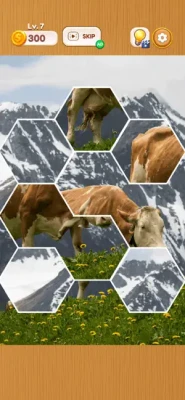
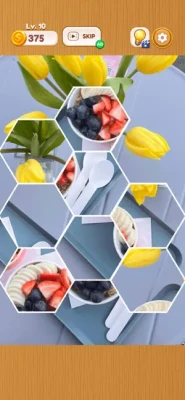
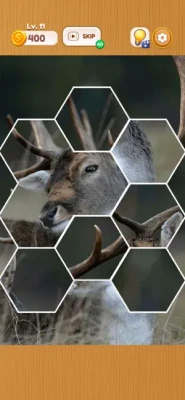
The game moves away from traditional square tiles and cardboard-cut puzzles in favor of a hexagonal grid system. Players are tasked with reconstructing beautiful, high-definition images by swapping and merging hexagonal fragments. The game emphasizes the "satisfaction" of completing intricate patterns and reveals stunning artwork upon successful completion of each level.
2. Key Features
Hexagonal Grid Logic: A unique 6-sided tiling system that offers more complex spatial puzzles than standard 4-sided blocks.
Swap & Merge Mechanics: Smooth, tactile gameplay where you interact with tiles to align them correctly within the master image.
High-Definition Imagery: Features a wide variety of "stunning" images, likely spanning nature, art, and abstract patterns.
Relaxing Pacing: Designed as a zen-like experience with no aggressive timers or high-pressure countdowns.
Progressive Complexity: Levels start with larger hex tiles and fewer pieces, evolving into intricate puzzles with hundreds of small hexagonal fragments.
3. How to Play
The Objective: Restore a scrambled image by moving hexagonal tiles into their correct positions within the grid.
Interaction: Most puzzles in this genre use a Tap-to-Swap or Drag-and-Drop mechanic. You select a tile and move it to where you believe it fits based on the visual patterns.
Visual Matching: Look at the textures, colors, and lines on the edges of each hexagon to see how they connect to the neighboring tiles.
Feedback: Tiles usually "lock" or glow when placed in the correct final position, providing immediate visual confirmation.
4. How to Win: Strategy & Tips
The "Edge" Technique: Start by identifying tiles with straight edges or unique border colors. These form the outer frame of the hexagon grid and provide a stable base to work inward.
Color Clustering: Group tiles by their dominant color palettes (e.g., all blue tiles for the sky, green for the grass). This narrows down your search area for each specific section.
Geometric Flow: Pay attention to the "flow" of lines. In a hexagonal grid, every piece has six connection points. If a line or gradient doesn't continue smoothly across an edge, the tile is likely rotated or in the wrong slot.
Work from the Centerpiece: If the image has a clear central subject (like a flower or a face), assemble that first. It’s easier to build the background around a finished subject than vice versa.
5. Technical Details
Developer: M8 OYUN YAZILIM VE PAZARLAMA ANONIM SIRKETI (M8 Games)
Platform: iOS, iPadOS, and macOS (Apple Silicon)
Size: 314.3 MB
Compatibility: * iPhone/iPad: Requires iOS 16.0 or later.
Mac: Requires macOS 13.0 or later and an M1 chip or later.
Apple Vision: Requires visionOS 1.0 or later.
Languages: English, Spanish, and Turkish.
Privacy: The developer declares minimal data collection (identifiers and diagnostics) used for analytics and advertising; data is not linked to your identity.
Monetization: Free-to-play with integrated advertising.
Rate the Game
User Reviews










Popular Games




















 Android
 iOS
iOS Windows
 Xbox
Xbox