



Latest Version
October 04, 2025
Bethesda Softworks LLC
management
iOS
0
Report a Problem
More About :game
Fallout Shelter puts you in charge of a Vault hidden deep beneath the post-apocalyptic wasteland.
Your role is that of the Overseer, responsible for building and maintaining an underground community while protecting its residents from the dangers of the outside world.
The basic idea sounds straightforward:
Build the Vault → Manage Dwellers → Produce Resources → Explore → Defend → Expand
But maintaining a successful Vault requires constant decision-making.
Every new room, resident, weapon, outfit and expedition can affect the long-term survival of your community.
The game is part of Bethesda's Fallout franchise and has remained one of its most recognizable mobile titles since its original release. The current U.S. App Store listing shows a 4.8-star rating from more than 563,000 ratings and an Editors' Choice designation.
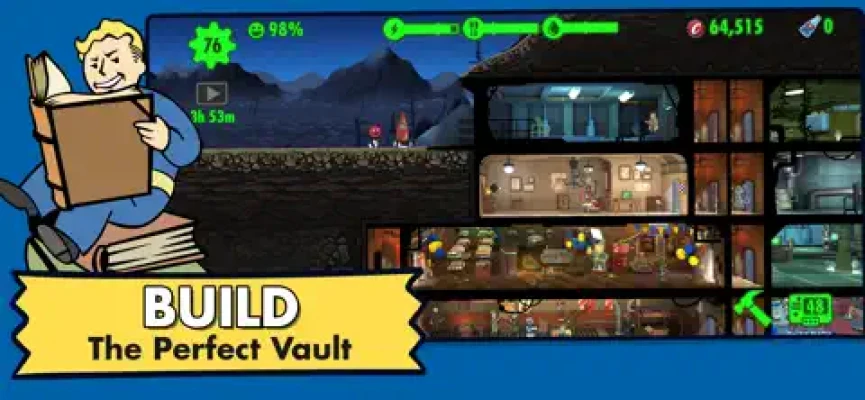
Build Your Underground Vault
The Vault is the heart of Fallout Shelter.
You begin with a relatively small underground facility and gradually transform it into a functioning settlement.
Different rooms serve different purposes, including resource production, training, storage, living areas and other Vault functions.
As your population grows, you need to expand carefully.
Building too quickly can create resource problems, while expanding too slowly can limit your Vault's potential.
The goal is to create a balanced underground community capable of supporting its residents while surviving attacks and unexpected events.
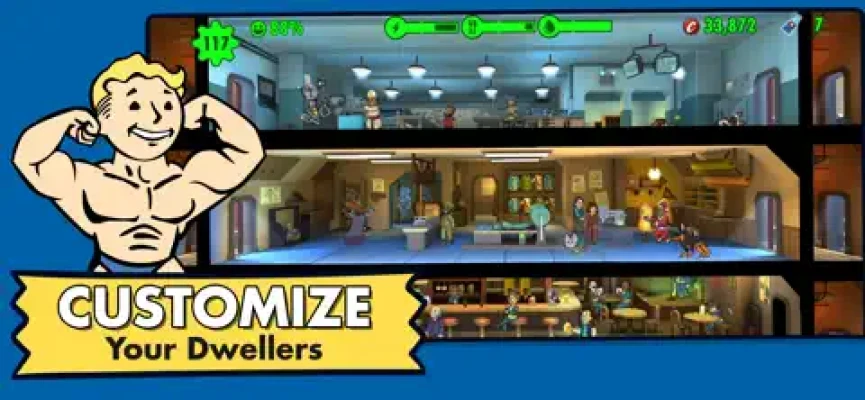
Manage Your Dwellers
Your Vault is only as strong as the people living inside it.
Dwellers have different abilities, strengths and weaknesses, so assigning them to suitable jobs is essential.
A resident with strong Strength may be more useful in one type of room, while another Dweller with high Intelligence may perform better elsewhere.
The game uses the familiar Fallout S.P.E.C.I.A.L. system:
- Strength
- Perception
- Endurance
- Charisma
- Intelligence
- Agility
- Luck
Training residents to improve these attributes is an important part of long-term Vault management.
Resource Management
A successful Vault needs a reliable supply of essential resources.
Your residents work in production rooms to keep the settlement running.
Resource management becomes increasingly important as your population grows.
You need to balance:
- Power
- Food
- Water
- Storage
- Population
- Room capacity
- Equipment
- Training
- Exploration
A growing population creates greater demand, meaning your production infrastructure must grow alongside your community.
Keep Your Dwellers Happy
Fallout Shelter isn't simply about keeping everyone alive.
You also need to maintain the happiness of your residents.
Dwellers have individual needs, jobs and relationships, and their overall happiness can influence the atmosphere of the Vault.
Assigning residents to suitable jobs is one of the easiest ways to improve their effectiveness and satisfaction.
The game encourages you to think of the Vault as a living community rather than simply a collection of rooms.
Explore the Wasteland
The surface world is dangerous, but it is also filled with valuable opportunities.
You can send Dwellers outside the Vault to explore the devastated Wasteland.
Explorers can encounter:
- Enemies
- Quests
- Valuable loot
- Weapons
- Armor
- Caps
- Experience
- Unexpected encounters
The Wasteland creates an important risk-versus-reward decision.
Sending a well-equipped Dweller outside can produce excellent rewards, but an unprepared explorer may struggle against the dangers of the post-nuclear world.
Complete Quests
Questing gives Fallout Shelter a more active adventure component.
Instead of simply watching your Vault operate, you can send selected Dwellers on missions beyond its walls.
Quests can introduce new locations, enemies, objectives and rewards.
This provides another way to obtain useful equipment and experience while expanding the game's narrative side.
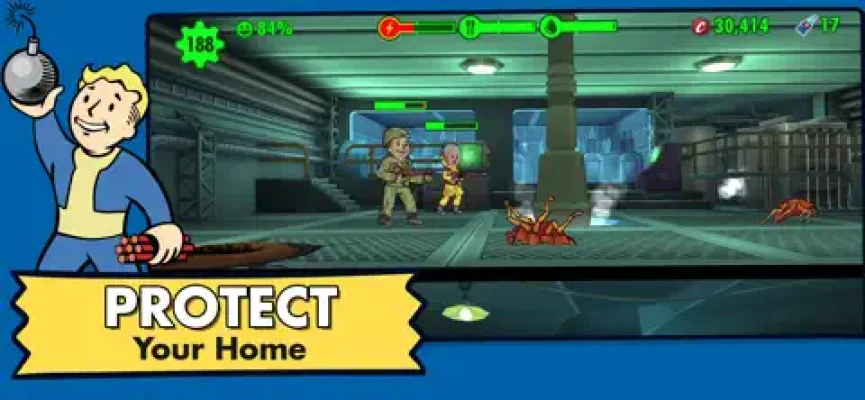
Defend Your Vault
Life underground isn't always peaceful.
Your Vault can face attacks and other threats that require properly equipped Dwellers to respond.
Defense therefore needs to be planned before an emergency happens.
Strong weapons, suitable outfits and well-trained residents can make the difference between a manageable incident and a serious Vault crisis.
The official listing specifically highlights defending the Vault against radioactive threats and other dangers of the Wasteland.
Weapons and Outfits
Equipment plays a major role in Fallout Shelter.
Dwellers can be equipped with different weapons and outfits to improve their effectiveness.
Equipment is useful both inside and outside the Vault.
Explorers need appropriate gear for Wasteland expeditions, while residents assigned to defensive positions benefit from strong weapons when threats appear.
You can also collect and craft equipment as your Vault develops.
Crafting System
Fallout Shelter includes crafting mechanics that allow you to turn collected materials into useful equipment.
This adds another layer to resource management.
Instead of treating every item you discover as something to sell or store, you can consider whether it could contribute to a better weapon or outfit.
Crafting therefore connects several parts of the game:
Explore → Collect Materials → Craft Gear → Equip Dwellers → Explore Further
Train Your Dwellers
Training is essential for building specialized residents.
Rather than waiting for every Dweller to improve naturally, you can develop their S.P.E.C.I.A.L. attributes through dedicated training.
This lets you create residents who are better suited to particular roles.
A well-organized Vault can therefore have different Dwellers specializing in different responsibilities.
Population Growth
A Vault needs people to function and expand.
As you attract and acquire additional Dwellers, your community becomes larger and more productive.
However, population growth also creates new demands.
More residents mean:
- More food consumption
- More water requirements
- Greater power demand
- More living space
- More potential workers
- More opportunities for specialization
Managing this balance is one of the central challenges of Fallout Shelter.
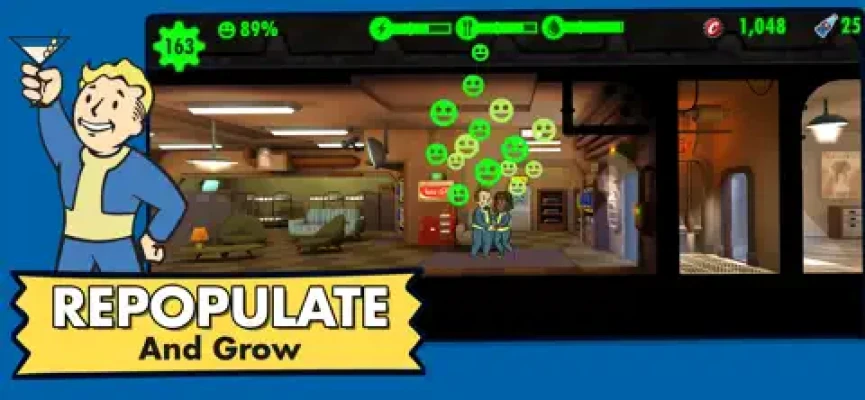
Relationships and Family
Fallout Shelter also incorporates relationships between Dwellers.
The game allows players to act as a matchmaker and help repopulate the underground community.
This adds a social layer to the simulation and makes the residents feel more like individual characters rather than interchangeable workers.
Vault Expansion
As your population and resources increase, you can expand your underground facility.
Expansion should be planned rather than performed randomly.
A well-designed Vault can make resource production, resident movement and defense more efficient.
Many experienced players spend considerable time experimenting with different Vault layouts and room arrangements.
How to Play Fallout Shelter
Step 1: Build Essential Rooms
Start by establishing the rooms necessary to produce your basic resources.
Step 2: Assign Dwellers Carefully
Place residents in rooms where their S.P.E.C.I.A.L. abilities are most useful.
Step 3: Monitor Resources
Keep an eye on power, food and water before expanding too aggressively.
Step 4: Train Your Residents
Improve important attributes so your Dwellers become more effective.
Step 5: Equip Your Best Dwellers
Give suitable weapons and outfits to residents responsible for defense or exploration.
Step 6: Explore the Wasteland
Send prepared Dwellers outside to collect experience, equipment and valuable resources.
Step 7: Complete Quests
Use quests to gain additional rewards and experience.
Step 8: Expand the Vault
Once your economy is stable, add new rooms and increase your community's capabilities.
Beginner's Guide
Don't Expand Too Quickly
A larger Vault isn't automatically a better Vault.
Every new room can increase your resource requirements.
Make sure your production capacity can support your expansion.
Assign Residents by S.P.E.C.I.A.L.
Don't randomly place Dwellers.
Check their abilities and put them where they can contribute most effectively.
Equip Your Defenders
Don't leave your defensive positions poorly equipped.
A few strong weapons can make a major difference during an attack.
Prepare Wasteland Explorers
Before sending someone outside, provide appropriate equipment and supplies.
A strong explorer can return with valuable rewards.
Train Specialized Dwellers
Rather than making every resident average at everything, consider creating specialists for particular jobs.
Advanced Vault Strategy
1. Build a Balanced Economy
Power, food and water should remain stable before you focus heavily on cosmetic or secondary improvements.
2. Create Specialized Residents
Train Dwellers around their strongest attributes instead of trying to make everyone identical.
3. Equip Your Best Explorers
Wasteland expeditions become much more productive when the right residents have strong gear.
4. Maintain Defensive Readiness
Keep your strongest defensive Dwellers appropriately equipped and positioned.
5. Think Before Increasing Population
More Dwellers can mean more workers, but they also increase your resource requirements.
6. Upgrade Strategically
Don't automatically upgrade every room the moment an upgrade becomes available.
Consider whether the additional capacity or production is actually needed.
Wasteland Exploration Tips
The Wasteland is one of Fallout Shelter's biggest sources of adventure.
Before sending a Dweller outside:
Check their abilities.
Equip appropriate gear.
Provide sufficient supplies.
Choose residents with good survivability.
Once an explorer is outside, monitor their progress and make sure they can survive the expedition.
The goal is not simply to send as many people outside as possible.
It's to send the right people with the right equipment.
Quest Strategy
Quests are useful for more than entertainment.
They can provide experience, equipment and other rewards while allowing your Dwellers to encounter situations beyond ordinary Vault management.
Build a small group of capable questers and give them strong equipment.
Having experienced residents ready for missions can make your Vault more flexible.
Vault Defense Strategy
When an attack occurs, don't panic.
The most important preparation happens before the attack.
Maintain:
- Strong weapons
- Well-trained residents
- Properly assigned defenders
- Stable resource production
- Appropriate room upgrades
A strong defense strategy reduces the chance that an unexpected event will destabilize your entire Vault.
Fallout Shelter Seasons and New Content
Fallout Shelter has continued receiving new content well beyond its original release.
The current App Store listing highlights a Synthetic Identity season featuring the Institute and human-like Synths. Players can complete challenges to unlock Kellogg and a new Vault theme.
The version history also records recent seasonal and experimental-Vault content.
Experimental Vaults
Recent updates have introduced themed experimental Vaults with special objectives and rewards.
One update centered on an Enclave-themed Vault, where players defend their facility, complete quests and collect gold bullion.
Another update introduced Ultracite Fever, featuring an Experimental Vault built around Ultracite deposits, Scorched enemies and new weaponry.
These additions give the long-running game new ways to approach Vault management.
Seasonal Gameplay
Fallout Shelter's newer content includes limited-time seasonal experiences.
The game's version history shows the introduction of Fallout Seasons, with special Vaults, challenges and rewards.
These events can introduce:
- New characters
- Outfits
- Weapons
- Recipes
- Vault themes
- Seasonal objectives
- Special rewards
Bethesda has therefore expanded Fallout Shelter beyond its original Vault-building formula with recurring themed content.
Fallout Shelter and the Fallout Universe
One of the game's biggest strengths is its connection to the wider Fallout franchise.
The familiar visual style, Vault-Tec technology, S.P.E.C.I.A.L. system, Caps, Wasteland exploration and recognizable characters make it immediately recognizable to Fallout fans.
At the same time, its simulation-focused structure makes it different from the traditional Fallout RPG formula.
Instead of directly controlling one hero through a large open world, you oversee an entire underground community.
Graphics and Presentation
Fallout Shelter uses a distinctive stylized interpretation of the Fallout universe.
The game combines colorful 2D visuals with the franchise's post-apocalyptic atmosphere.
Its cartoon-inspired presentation makes the Vault feel approachable while retaining recognizable Fallout elements.
The contrast is intentional:
Cheerful Vault life above ground? Not quite.
Behind the bright colors are resource shortages, attacks, dangerous expeditions and difficult decisions.
Game Difficulty
Fallout Shelter is relatively easy to understand but becomes more demanding as your Vault grows.
Early challenges are mostly about learning:
- Resource production
- Room placement
- Dweller assignments
- Population management
- Basic defense
Later, the challenge becomes maintaining a large and efficient community.
The larger your Vault becomes, the more interconnected its systems are.
A shortage of power can affect production.
A shortage of food can hurt your residents.
Poorly trained Dwellers can make defense harder.
Unprepared explorers can fail in the Wasteland.
This interconnected structure creates much of the game's long-term appeal.
Player Ratings and Reception
The current U.S. App Store listing shows 4.8 out of 5 stars from approximately 563,000 ratings, making Fallout Shelter one of the most heavily reviewed games in its category on the store. It is also listed as an Editors' Choice title.
The game's longevity is another notable strength. It has continued receiving new seasonal and Vault-related content years after its original launch.
Recent updates show Bethesda continuing to introduce new challenges, characters, themes and experimental Vaults rather than leaving the game unchanged.
Pros and Cons
Pros
- Authentic Fallout setting
- Deep Vault-building system
- Resource management
- S.P.E.C.I.A.L. character progression
- Dweller specialization
- Wasteland exploration
- Quest system
- Crafting
- Weapons and outfits
- Vault defense
- Population management
- Strong replay value
- Seasonal content
- Experimental Vaults
- Large player community
- Excellent App Store rating
- Free-to-play entry
Cons
- In-app purchases are prominent
- Large Vaults can become increasingly complex to manage
- Some progression can involve repetitive resource management
- The game includes advertising
- Long-term players may find some routine Vault tasks repetitive
- Seasonal content can add additional systems to manage
Ads and In-App Purchases
Fallout Shelter is free to download and contains optional in-app purchases.
The U.S. App Store lists purchases including:
- Lunchboxes
- Mr. Handy bundles
- Pet Carriers
- Starter Packs
- Nuka-Cola Quantum
- Other item bundles
The current listing also confirms that the game contains advertising and in-app purchases.
Technical Details
| Feature | Information |
|---|---|
| Game | Fallout Shelter |
| App Store ID | 991153141 |
| Developer | Bethesda |
| Category | Simulation |
| Price | Free |
| In-App Purchases | Yes |
| App Size | About 676 MB |
| U.S. Rating | 4.8/5 |
| Ratings | 563K+ |
| Age Rating | 13+ |
| Required iOS | iOS 13.0 or later |
| Required iPadOS | iPadOS 13.0 or later |
| Languages | English, French, German, Italian, Russian, Spanish |
| Platforms | iPhone, iPad, iPod touch, Apple Vision |
| Advertising | Yes |
These specifications are based on the current U.S. App Store listing.
Is Fallout Shelter Free?
Yes. Fallout Shelter is free to download, with optional in-app purchases.
Is Fallout Shelter Available on iPhone?
Yes. The current listing supports iPhone devices running iOS 13.0 or later.
Is Fallout Shelter Available on iPad?
Yes. It supports iPad and requires iPadOS 13.0 or later.
What Is the Goal of Fallout Shelter?
Your goal is to build and manage a successful underground Vault, keep Dwellers productive and happy, gather resources, explore the Wasteland and protect the community.
What Are S.P.E.C.I.A.L. Abilities?
S.P.E.C.I.A.L. represents the seven core character attributes used throughout Fallout: Strength, Perception, Endurance, Charisma, Intelligence, Agility and Luck.
Training these abilities helps Dwellers become better suited to different roles.
Can You Explore the Wasteland?
Yes. You can send Dwellers outside the Vault to explore the post-apocalyptic Wasteland, complete quests and find equipment, experience and other rewards.
Can You Craft Weapons?
Yes. Crafting is part of Fallout Shelter's progression, allowing you to turn collected materials into useful equipment.
Can You Train Dwellers?
Yes. Dwellers can train to improve their S.P.E.C.I.A.L. abilities.
Can Dwellers Have Relationships?
Yes. Fallout Shelter includes relationship and population mechanics, allowing you to play matchmaker and help repopulate your Vault.
Does Fallout Shelter Have Quests?
Yes. Dwellers can be sent on quests and Wasteland missions to discover new locations and collect rewards.
Does Fallout Shelter Still Receive Updates?
Yes. The current App Store version history shows recent seasonal and experimental-Vault updates, including new characters, themes, quests, weapons and rewards.
Does Fallout Shelter Have In-App Purchases?
Yes. The App Store lists Lunchboxes, Mr. Handy bundles, Pet Carriers, Starter Packs, Nuka-Cola Quantum and other purchases.
What Is Fallout Shelter's Age Rating?
The U.S. App Store currently rates Fallout Shelter 13+ and lists cartoon/fantasy violence, mature or suggestive themes, alcohol/tobacco/drug references and guns or other weapons among its content.
Best Fallout Shelter Strategy
The most important principle is balance.
Don't build a huge Vault simply because you have enough Caps.
Every expansion creates additional demands.
Instead:
Build → Stabilize → Train → Equip → Explore → Expand
This approach keeps your resource economy under control while gradually increasing your Vault's strength.
Best Dweller Strategy
Don't treat every Dweller equally.
Look at their S.P.E.C.I.A.L. attributes and assign them accordingly.
Create specialists rather than generalists whenever possible.
For example, if a Dweller has particularly strong abilities suited to a specific role, train that resident further instead of trying to improve every attribute equally.
This creates a more efficient Vault workforce.
Best Wasteland Strategy
Before sending a Dweller into the Wasteland, ask three questions:
Are they well trained?
Do they have good equipment?
Can they survive the expedition?
A strong explorer can bring back useful weapons, outfits, Caps, experience and materials.
A poorly prepared explorer can turn a potentially profitable expedition into a rescue mission.
Why Play Fallout Shelter?
Fallout Shelter succeeds because it combines several gameplay systems that naturally reinforce each other.
Building creates the Vault.
Dwellers make the Vault function.
S.P.E.C.I.A.L. training improves your workforce.
Crafting provides better equipment.
Exploration brings back valuable rewards.
Quests provide additional objectives.
Defense protects everything you've built.
That interconnected structure makes Fallout Shelter more than a simple base-building game.
Final Verdict
Fallout Shelter remains one of the most recognizable mobile management games in the Fallout universe.
Its combination of Vault construction, resource management, Dweller progression, S.P.E.C.I.A.L. training, Wasteland exploration, crafting, quests and defense gives it a substantial amount of content for a free mobile game.
Its enormous U.S. App Store review base—more than 563,000 ratings with a 4.8-star average—shows how durable its appeal has been.
More importantly, Bethesda continues to add new seasonal experiences and experimental Vaults. The current listing features Synthetic Identity, while recent updates have introduced Institute, Enclave and Ultracite-themed content.
Rate the Game
User Reviews















Popular Games



















 Android
 iOS
iOS Windows
 Xbox
Xbox