





Latest Version
August 29, 2026
SayGames LTD
Puzzle
iOS
0
Report a Problem
More About :game
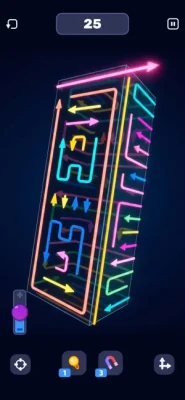
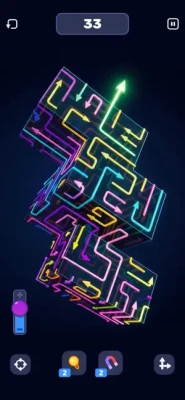
Cube Way Out is a casual 3D puzzle game developed by SayGames LTD. The main objective is simple: remove every arrow from a three-dimensional cube without causing the arrows to collide.
Each puzzle presents a cube covered with arrows pointing in different directions. Players tap an arrow to release it, but the move only works when the arrow has a clear path. That simple rule creates increasingly complicated situations where the order of your moves matters.
The ability to rotate the cube adds an important spatial element. What looks blocked from one angle may reveal a completely different solution after turning the cube.
Cube Way Out Gameplay Overview
The gameplay revolves around three basic actions:
- Examine the arrows on the cube.
- Decide which arrow can safely escape.
- Rotate the cube to discover additional paths and hidden possibilities.
The challenge is not speed. It is deciding which arrow should move first.
A careless tap can interfere with another arrow or waste an opportunity. Successful players learn to examine the entire cube before committing to a move.
How to Play Cube Way Out
Getting started is straightforward:
- Look at all visible arrows.
- Identify arrows with an unobstructed path.
- Tap a safe arrow to release it.
- Rotate the 3D cube when you need another viewpoint.
- Reassess the remaining arrows.
- Continue removing arrows until the cube is completely clear.
The controls are intentionally simple, but solving harder levels requires much more careful thinking.
The 3D Cube Puzzle Mechanic
The three-dimensional cube is what gives Cube Way Out its identity.
Instead of solving a flat puzzle, you need to understand how arrows are positioned around multiple sides of the cube. Rotating the structure lets you inspect different faces and discover paths that may not be obvious from the starting view.
This creates a useful spatial-awareness challenge because players must mentally connect what they see on one side with what is happening elsewhere on the cube.
Free the Arrows
The central objective is to free every arrow.
Each arrow has a direction, and it can only escape when the space ahead is clear. This turns the puzzle into an ordering problem.
For example, an arrow may appear ready to leave, but another piece could be blocking its route. Removing the blocking arrow first may then open the path for several additional moves.
The best solution therefore isn't always the most obvious move.
Arrow Sorting and Logic Challenges
Although Cube Way Out can look like an arrow sorting game, its real challenge is closer to spatial logic and path planning.
You need to identify dependencies between arrows and determine the correct sequence for clearing them.
As levels become more complicated, several arrows may appear to interfere with one another. This forces you to slow down, rotate the cube, and search for a safe starting point.
Hundreds of Puzzle Levels
Cube Way Out offers hundreds of unique escape puzzle levels, ranging from relatively straightforward cubes to much more tangled arrangements.
The progression gives the basic mechanics plenty of room to develop. Early puzzles introduce the concept, while later cubes demand greater attention to arrow direction, positioning, and move order.
No Countdown Timer
One of the most appealing aspects of Cube Way Out is its relaxed approach to puzzle solving.
There is no countdown forcing you to finish a level within a few seconds. You can rotate the cube, inspect the available routes, and think about the consequences of a move before tapping.
This makes the game suitable for players who enjoy brain teasers without the pressure found in fast-paced puzzle games.
Boosters and Helpful Tools
Cube Way Out includes boosters designed to make difficult puzzle situations more manageable.
These tools can be particularly useful when you reach a cube where the correct solution is difficult to identify. Rather than changing the basic objective, boosters provide assistance while allowing the core logic puzzle to remain intact.
Graphics and Visual Design
The game uses a minimalist visual style built around a dark background and brightly colored, neon-like arrows.
This contrast helps the arrows stand out clearly from the cube and keeps attention focused on the puzzle. The presentation is deliberately clean rather than overloaded with decorative elements.
Game Difficulty
Cube Way Out begins with an approachable concept, but the puzzles become substantially more demanding as more arrows become tangled together.
The difficulty comes from:
- Choosing the correct starting arrow
- Understanding arrow directions
- Identifying blocked paths
- Rotating the cube effectively
- Planning several moves ahead
- Avoiding unnecessary mistakes
Players who enjoy spatial reasoning and logic puzzles should find the increasing complexity rewarding.
Beginner's Guide
If you are new to Cube Way Out, don't immediately tap the first arrow that appears to have an open route.
Instead, spend a few seconds examining the whole cube.
Look for Clearly Free Arrows
Start by finding arrows whose entire route appears unobstructed.
Rotate Before You Commit
The initial camera angle doesn't necessarily show the complete solution. Rotate the cube and inspect the other sides.
Think About Dependencies
Ask yourself which arrows are blocking other arrows. Removing a blocker can sometimes open several paths.
Don't Rush
The lack of a timer gives you plenty of opportunity to think. Use it.
Advanced Strategy Tips
Find the Critical Arrow
Some arrows are more important than others because they prevent several other pieces from moving. Identifying these critical blockers can dramatically simplify a level.
Check Multiple Angles
A path that looks impossible from one perspective may become obvious after rotating the cube.
Plan the Sequence
Don't simply ask whether an arrow can move. Ask whether moving it now will make the remaining puzzle easier.
Work From the Outside In
When possible, prioritize arrows that have obvious escape routes and gradually expose the more complicated sections of the cube.
Avoid Random Tapping
Cube Way Out rewards deliberate decisions. Random moves can create unnecessary complications, especially on tightly packed levels.
Controls and Interface
Cube Way Out uses simple touch controls designed for mobile devices.
Players tap arrows to release them and interact with the 3D cube to rotate the view. The controls are easy to learn, allowing the puzzle itself rather than a complicated interface to remain the focus.
The App Store lists the game for iPhone and iPad, with compatibility beginning at iOS 15.0 for iPhone and iPadOS 15.0 for iPad.
Game Progression
Progression is based primarily on solving increasingly challenging cube puzzles.
There is no traditional character class, weapon system, or RPG-style leveling structure. Instead, your progress is measured by the number and complexity of cubes you successfully clear.
This approach keeps the focus firmly on puzzle-solving ability.
Spatial Awareness Challenge
Cube Way Out is particularly interesting because it adds a three-dimensional perspective to a familiar logic-puzzle concept.
Players aren't only matching colors or arranging objects. They must understand direction, depth, position, and the relationship between different faces of a cube.
That makes the game a useful choice for anyone who enjoys spatial brain teasers.
What Makes Cube Way Out Different?
Many casual puzzle games use flat boards and simple matching mechanics.
Cube Way Out takes a different route by putting the puzzle inside a rotatable 3D structure. Every arrow has a direction, and every move can change the available possibilities.
The combination of 3D cubes + arrow paths + move order + spatial reasoning gives the game a distinct identity.
Game Modes
Cube Way Out is centered around its main 3D escape puzzle mode.
Each level presents a new cube configuration, with the variety coming from different arrow arrangements, increasing complexity, and newer mechanics.
This keeps the gameplay focused rather than dividing the experience into several unrelated modes.
Updates and New Mechanics
The App Store currently shows version 1.6.0 and notes that new mechanics have been added. Version 1.5.0 was also listed with new mechanics. The current App Store listing was updated recently, making it useful to check the store page for the newest available version before publishing a permanent technical-information section.
The Google Play listing also reports a recent August 13, 2026 update and notes that new levels were added.
Technical Details
Developer: SayGames LTD
Genre: Puzzle
Age Rating: 4+
Price: Free with optional in-app purchases
Platforms: iPhone, iPad
iOS Requirement: iOS 15.0 or later
iPad Requirement: iPadOS 15.0 or later
Languages: English plus 18 additional languages
App Size: Approximately 342.8 MB
Advertising: Yes
In-App Purchases: Yes
The App Store also lists support for Mac with an Apple M1 chip or later and Apple Vision, subject to the platform requirements shown on the store page.
In-App Purchases and Advertising
Cube Way Out is free to download but contains advertising and optional in-app purchases.
The current US App Store listing includes purchases such as No Ads, No Ads Bundle, coin packs, a revive pack, and other offers.
Players who prefer an uninterrupted experience can therefore choose the available ad-removal option rather than relying exclusively on the free version.
Player Experience
Cube Way Out has received generally positive feedback on the App Store, where the current listing shows a 4.6/5 rating from approximately 3.6K ratings. Recent reviews describe the game as challenging and enjoyable, while some players have mentioned interface and control frustrations.
That combination is worth highlighting: the game's central puzzle concept is widely appealing, but the increasing difficulty and touch interaction can make certain levels demanding.
Pros and Cons
Pros
- Clever 3D puzzle concept
- Easy-to-understand controls
- Hundreds of levels
- Increasing difficulty
- Rotatable cube gameplay
- Strong spatial reasoning element
- Colorful arrow design
- Minimalist presentation
- No countdown timer
- Boosters for difficult situations
- Short levels suitable for quick sessions
- Available on iPhone and iPad
Cons
- Later puzzles can become quite challenging
- Advertising is included
- Optional purchases are available
- Touch controls can occasionally feel sensitive
- Some players may find the interface distracting during difficult puzzles
Who Should Play Cube Way Out?
Cube Way Out is a good choice for players who enjoy:
- 3D puzzle games
- Logic games
- Brain teasers
- Spatial reasoning games
- Escape puzzles
- Arrow puzzles
- Casual mobile games
- Relaxing puzzle games
- Strategy-based puzzles
- Short gaming sessions
- Challenging brain games
It is particularly appealing if you like puzzles where finding the correct order of moves matters more than reaction speed.
Cube Way Out vs Traditional Puzzle Games
Traditional matching or sorting puzzles often ask players to group similar objects or clear a flat board.
Cube Way Out takes a more spatial approach. Instead of simply matching pieces, you must understand how arrows move through a 3D environment and decide which piece should be removed first.
The ability to rotate the cube gives the game another layer of discovery. A puzzle can look blocked from one angle but solvable from another.
Is Cube Way Out Relaxing?
Despite its increasingly difficult puzzles, Cube Way Out is designed as a relatively relaxed brain game.
There is no countdown timer, so players can take their time examining the cube and deciding on the correct sequence. The minimalist presentation and short levels also make it suitable for casual play.
Is Cube Way Out Difficult?
The basic rules are easy to understand, but the puzzles become harder as the arrow arrangements become more complicated.
The most difficult levels require players to think several moves ahead and understand how removing one arrow changes the available paths for others.
So while the controls remain simple, the actual problem-solving challenge can become surprisingly demanding.
Expert Rating
Overall Rating: 8.7/10
Puzzle Design: 9/10
Gameplay: 8.8/10
Originality: 8.7/10
Graphics: 8.4/10
Accessibility: 8.5/10
Replay Value: 8.8/10
Relaxation: 8.6/10
Cube Way Out succeeds because it takes a simple idea and adds a meaningful third dimension. The result is easy to understand but difficult to master.
Final Verdict
Cube Way Out: Puzzle Escape is a smart choice for anyone looking for a colorful 3D brain game with straightforward controls and increasingly challenging logic puzzles.
Its strongest feature is the way the cube changes the traditional puzzle formula. Players need to consider arrow direction, blocked paths, move order, and different viewing angles before making decisions.
The absence of a countdown timer makes the experience more comfortable, while hundreds of levels provide plenty of content for players who enjoy solving one puzzle after another.
If you like 3D puzzle games, logic challenges, arrow puzzles, spatial reasoning, and relaxing brain teasers, Cube Way Out is worth adding to your mobile-game collection.
Frequently Asked Questions
What is Cube Way Out: Puzzle Escape?
Cube Way Out is a 3D logic puzzle game where players free arrows trapped inside a cube without allowing them to collide.
How do you play Cube Way Out?
Tap an arrow when its path is clear, release it from the cube, and continue until all arrows have escaped. You can rotate the cube to examine different sides and discover additional solutions.
Does Cube Way Out have a timer?
No. The game does not use a countdown timer, allowing players to solve the puzzles at their own pace.
Does Cube Way Out have 3D levels?
Yes. Every puzzle is presented as a 3D cube containing arrows pointing in different directions.
How many levels does Cube Way Out have?
The App Store describes the game as having hundreds of unique escape puzzle levels, ranging from simple cubes to more complicated arrangements.
Can you rotate the cube in Cube Way Out?
Yes. Rotating the cube is a major part of the gameplay because it lets you inspect different sides and identify hidden or previously blocked possibilities.
Is Cube Way Out free?
Yes. Cube Way Out is free to download, but the game contains advertising and optional in-app purchases.
Is Cube Way Out available on iPhone?
Yes. The App Store lists Cube Way Out for iPhone and iPad, with iOS 15.0 or later required on iPhone.
Who developed Cube Way Out?
Cube Way Out: Puzzle Escape was developed by SayGames LTD.
Is Cube Way Out good for brain training?
The game is designed around logic, spatial awareness, sorting, and problem-solving challenges. It can provide a casual mental workout, although it should be viewed as entertainment rather than a formal cognitive-training program.
Rate the Game
User Reviews










Popular Games



















 Android
 iOS
iOS Windows
 Xbox
Xbox