
Latest Version
September 25, 2026
Buzzy Party
Trivia
Android
0
com.casino.al3ab
Report a Problem
More About :game
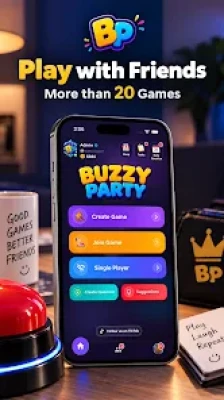
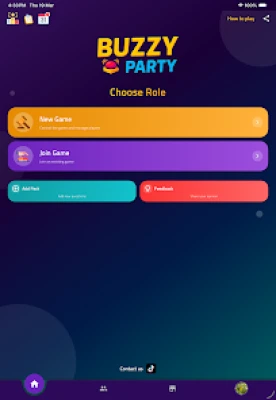
The game is designed for groups rather than solo grinding. Depending on the mode, players may need to answer questions quickly, identify an imposter, guess a character, draw clues, crack a code, imitate sounds or compete for the highest score.
The current Google Play listing describes the game as suitable for 3 to 12+ players, making it particularly suited to family gatherings, friends' game nights and casual group sessions.
Game Overview
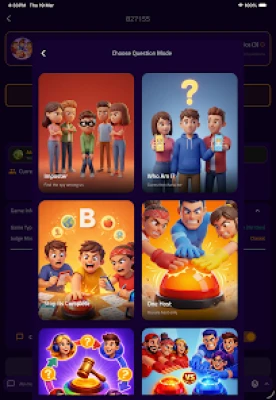
Buzzy Party combines several different party-game styles inside one app.
Instead of repeating one gameplay mechanic, you can switch between trivia, guessing, deception, drawing, word challenges and voice-based competitions.
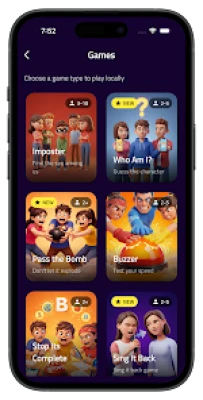
The main experience includes:
- Voice Mimic
- Mafia
- Spy / Imposter
- Who Am I
- Pass the Bomb
- Sing It Reversed
- Classic Buzzer
- Draw & Guess
- Stop Complete
- Guess The Code
- Higher or Lower
- Points Mode
- Classic Mode
- Rondo Mode
- Team Mode
How Buzzy Party Works
The easiest way to understand Buzzy Party is to divide its modes into two groups.
Offline Party Games
Several games can be played locally using one device. These include Mafia, Spy/Imposter, Who Am I, Pass the Bomb, Sing It Reversed and Classic Buzzer.
These modes are useful when everyone is sitting together and you want a quick game without requiring every player to install the app.
Online Multiplayer Games
Other modes allow players to participate across multiple devices.
Online options include Voice Mimic, Draw & Guess, Spy/Imposter, Who Am I, Stop Complete, Guess The Code, Higher or Lower and several trivia formats.
Buzzy Party Voice Mimic Guide
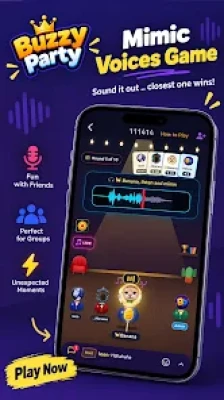
Voice Mimic is one of the newest additions to Buzzy Party.
The basic idea is simple: listen carefully to a sound or effect, reproduce it through your microphone and compete for the highest score. The current listing specifically highlights Voice Mimic as a new online game.
Voice Mimic Tips
Listen before making a sound.
Do not rush immediately after hearing the prompt. Pay attention to the sound's rhythm, length and distinctive characteristics.
Focus on the main sound.
You do not necessarily need to reproduce every tiny detail. Concentrate on the part that makes the sound recognizable.
Control your microphone distance.
Being extremely close to the microphone can produce distorted audio, while standing too far away can make your imitation difficult to detect.
Keep background noise low.
A quiet environment makes it easier for the game to capture your imitation.
Experiment with your voice.
Some sounds may work better with a higher or lower pitch, while others benefit from short vocal bursts.
Buzzy Party Trivia Strategy
Trivia games reward both knowledge and speed.
The biggest mistake is pressing the buzzer before you have enough information to make a reasonable answer.
Read the Question Carefully
Look for the key part of the question rather than reacting to the first familiar word.
Think About Categories
If you regularly play trivia with friends, notice which subjects appear frequently. General knowledge, entertainment, geography, history and other categories can require different approaches.
Balance Speed and Accuracy
Being fast is useful, but repeatedly answering incorrectly can hurt your performance.
Try to recognize the answer quickly without sacrificing basic accuracy.
Build Your Own Trivia Packs
Buzzy Party's current feature set includes the ability to create custom trivia packs as well as use built-in questions.
Custom packs are particularly useful for themed game nights.
For example, groups could create questions around:
- Movies
- Football
- Video games
- Geography
- Music
- General knowledge
- Friends and family
- School subjects
Spy / Imposter Strategy Guide
Spy and Imposter games are based on observation, deduction and communication.
Your goal changes depending on whether you are the player trying to identify the spy or the hidden player attempting to avoid detection.
If You Are Not the Spy
Pay attention to how other players answer.
Look for:
- Contradictory answers
- Unusual hesitation
- Answers that are too vague
- Players copying another person's response
- Someone asking questions that reveal they do not understand the subject
Do not accuse someone solely because they answer differently from you. Look for a pattern.
If You Are the Spy
Your biggest objective is to gather information without exposing your lack of knowledge.
Listen carefully to everyone else's answers before committing yourself.
Avoid making your answer overly specific if you do not know the secret word.
At the same time, an answer that is too vague can make you suspicious.
The safest approach is usually to provide a believable response that fits what you have learned from the conversation.
Who Am I Strategy
Who Am I is a question-based guessing game.
Your objective is to identify the character assigned to you by asking useful questions.
Instead of asking random questions, eliminate large groups of possibilities.
For example, questions about broad characteristics can divide the possibilities quickly:
- Is the character fictional?
- Is the character a real person?
- Is the character associated with entertainment?
- Is the character known primarily for sports?
- Is the character from a movie or television series?
Once you narrow the category, ask more specific questions.
The Best Question Strategy
Think of every question as a way to reduce the number of possible answers.
A question that eliminates half the possibilities is generally more useful than a question that eliminates only one.
Draw & Guess Guide
Draw & Guess rewards communication through pictures rather than words.
The goal is not to create a beautiful drawing. The goal is to make your clue recognizable.
Drawing Tips
Start with the largest recognizable shape.
Then add one or two defining details.
Avoid filling the screen with unnecessary decorations.
For example, if you need to draw an animal, its silhouette and defining features may be more useful than detailed shading.
Guessing Tips
Look at the entire drawing rather than focusing on one isolated mark.
Think about what the artist could realistically draw within the available time.
If your first idea does not fit, quickly consider related categories.
Pass the Bomb Strategy
Pass the Bomb is built around pressure and fast answers. The listing identifies it as an offline game where players must answer quickly before the bomb explodes.
The best strategy is to avoid freezing when the pressure rises.
Prepare several possible answers mentally before your turn.
If the category is broad, choose a simple valid answer rather than wasting valuable time searching for the perfect response.
Speed matters, but knowing the rules of the current challenge matters just as much.
Classic Buzzer Tips
Classic Buzzer turns the phone into a fast trivia buzzer.
If you want to perform well:
- Keep your attention on the question.
- Listen for the complete clue.
- Identify the category.
- React quickly when confident.
- Avoid random buzzing.
- Remember questions you previously missed.
When playing with friends, the buzzer format can become highly competitive because reaction speed is almost as important as knowledge.
Stop Complete Strategy
Stop Complete challenges players to produce words beginning with a randomly selected letter.
A useful technique is to prepare mentally before the round.
Think about common categories and possible words for frequently used letters.
For example, you can mentally keep a few categories such as:
- Animals
- Countries
- Food
- Names
- Objects
- Sports
The more categories you can access quickly, the easier it becomes to respond under a time limit.
Guess The Code Guide
Guess The Code asks players to crack a three-digit secret code.
Treat every attempt as information.
Do not make completely random guesses repeatedly.
Instead:
- Remember previous attempts.
- Track numbers that appear useful.
- Look for patterns.
- Eliminate unlikely combinations.
- Avoid repeating the same unsuccessful approach.
The objective is to turn each guess into useful information for the next attempt.
Higher or Lower Strategy
Higher or Lower is another quick decision game in which players try to predict the next number relative to the current one.
Do not confuse a probability-based decision with certainty.
If you have already seen several high numbers, that does not guarantee the next number will be low.
Use the information available in the game, but avoid assuming that previous results automatically determine the next one.
Points Mode
Points Mode rewards correct answers within a time limit.
This changes the way you should approach trivia.
You need a balance between:
Knowledge + speed + consistency
If you know an answer immediately, respond quickly.
If you are uncertain, use the remaining time to eliminate possibilities rather than instantly guessing.
Classic, Rondo and Team Modes
Buzzy Party includes different ways to organize the classic buzzer experience.
Classic Mode
One host controls the buzzer trivia game.
Rondo Mode
The host changes from one round to another, giving different players a chance to manage the game.
Team Mode
Players form teams and compete against one another.
Team Mode can be especially useful when there is a larger group because it reduces the pressure on individual players and creates more discussion.
Best Buzzy Party Tips for Beginners
1. Start With Familiar Modes
If you are playing for the first time, begin with a simple trivia or guessing mode.
2. Learn the Rules Before Competing
Different modes require completely different strategies.
3. Keep the Group Moving
Party games become less enjoyable when players spend too much time between rounds.
4. Use Custom Trivia
Create questions around subjects your group actually enjoys.
5. Keep the Microphone Clear
This is particularly important for Voice Mimic.
6. Do Not Take Imposter Games Too Seriously
Deception games are designed around bluffing and suspicion.
7. Rotate Hosts
Changing the host can keep trivia rounds fresh.
8. Try Team Mode With Larger Groups
Teams can make large gatherings easier to manage.
9. Mix Fast and Slow Games
Alternate trivia with drawing, guessing and social deduction.
10. Choose Games Based on the Group
A group that loves trivia may prefer buzzer games, while a more social group may enjoy Imposter, Who Am I or Draw & Guess.
Buzzy Party Features
The current Google Play listing highlights several features that distinguish Buzzy Party from a single-mode trivia app:
- Online multiplayer
- Offline local games
- Voice-based challenges
- Real-time buzzer gameplay
- Social deduction
- Drawing games
- Character guessing
- Word challenges
- Number games
- Custom trivia packs
- Built-in questions
- Team play
- Games for 3 to 12+ players
Updates and Current Version
The Google Play listing shows Buzzy Party was updated on September 21, 2026, with the addition of Voice Mimic alongside performance improvements and bug fixes.
Third-party app tracking also identifies the package com.casino.al3ab as Buzzy Party: Mimic Voice and reports the app in the 1.8.x version series during September 2026.
Because the app is actively updated, individual game modes and features may change over time.
Buzzy Party Reviews and Player Experience
The current Google Play listing shows a 4.7-star rating with about 3.2K reviews and 500K+ downloads.
The game's current audience includes players looking for casual multiplayer trivia and party games. Reviews and platform listings also show that the app is used for playing with friends and family.
As with any multiplayer game, the experience can depend heavily on the group you play with, the selected game mode and the quality of the connection.
Pros and Cons
Pros
- Many different party-game formats
- Online and offline options
- Trivia and buzzer challenges
- Social deduction games
- Drawing and guessing games
- Voice Mimic mode
- Custom trivia packs
- Team Mode
- Supports groups of 3 to 12+ players
Cons
- Some modes work better with a larger group.
- Online modes depend on multiplayer participation.
- Voice-based games can be affected by microphone or background-noise conditions.
- The large number of game modes can take some time for new players to learn.
Is Buzzy Party Good for Game Night?
Buzzy Party is built specifically around group interaction rather than traditional single-player progression.
Its combination of trivia, social deduction, drawing, guessing, word challenges and voice games gives groups several different ways to play without switching to completely different apps.
The most enjoyable mode will depend on the people playing. Competitive trivia fans may prefer Classic Buzzer and Points Mode, while groups that enjoy bluffing or creativity can move toward Imposter, Who Am I and Draw & Guess.
Frequently Asked Questions
What is Buzzy Party: Mimic Voice?
Buzzy Party: Mimic Voice is a multiplayer party-game app featuring trivia, buzzer games, social deduction, drawing, guessing, word games and voice challenges.
Is Buzzy Party multiplayer?
Yes. It includes both local multiplayer games and online multiplayer modes.
How many people can play Buzzy Party?
The Google Play description says the game is designed for 3 to 12+ players, depending on the mode.
What is Voice Mimic?
Voice Mimic is an online game where players listen to a sound, reproduce it using their microphone and compete for a high score.
Can Buzzy Party be played offline?
Yes. Several listed games are designed for local play on one device, including Mafia, Spy/Imposter, Who Am I, Pass the Bomb, Sing It Reversed and Classic Buzzer.
Does Buzzy Party have trivia?
Yes. Trivia is one of the main parts of the app, with classic buzzer and points-based formats available.
Can you create custom questions?
Yes. The current listing says players can create custom trivia packs or use built-in questions.
Does Buzzy Party have Team Mode?
Yes. Team Mode allows players to form groups and compete against each other.
Final Tips for Buzzy Party
The biggest advantage of Buzzy Party is variety. You do not need to play every round the same way.
For trivia, concentrate on knowledge and reaction speed. For Imposter, observe player behavior and avoid revealing too much information. For Who Am I, ask questions that eliminate large groups of possibilities. For Draw & Guess, make simple recognizable drawings. For Voice Mimic, focus on sound quality, timing and microphone clarity.
Most importantly, choose the game mode that fits the group. Buzzy Party is designed around interaction, so the people around you are just as important to the experience as the game itself.
Rate the Game
User Reviews











Popular Games


















 Android
 iOS
iOS Windows
 Xbox
Xbox