







Latest Version
November 25, 2026
BKRXY LLC
Family
iOS
0
Report a Problem
More About :game
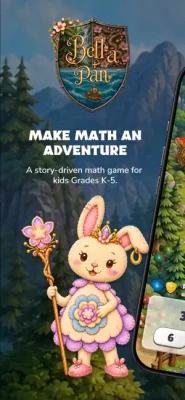
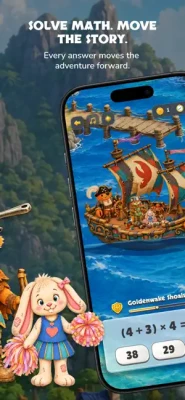
Instead of simply presenting children with a collection of arithmetic questions, Bella and Pan gives them a reason to solve each problem. Every correct answer helps the characters continue their journey, making mathematics feel like a meaningful part of the adventure.
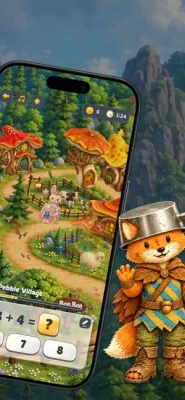
Players can choose between Bella and Pan, two adorable stuffed-animal explorers, and travel through three connected chapters. Their mission involves helping the children of Pebble Village recover their missing toys and stuffed animals. Along the way, they encounter friendly characters, explore different locations, overcome obstacles, and collect Adventure Coins.
The game covers several important mathematical skills, including addition, subtraction, multiplication, and division. Its difficulty settings allow children to begin with basic calculations and gradually explore more advanced challenges as their confidence improves.
Bella and Pan is particularly appealing to families looking for an educational game that offers entertainment without unnecessary distractions. It works offline, does not require an account, and does not include advertisements or in-app purchases.
What Makes Bella and Pan Special?
Bella and Pan stands out because it combines learning and storytelling rather than treating mathematics as an isolated activity.
An Adventure Built Around Mathematics
Every correct mathematical answer contributes to the characters' progress. Children can enjoy the storyline while practicing calculations, creating a connection between solving problems and achieving goals.
Two Playable Main Characters
Players can select Bella or Pan before beginning their adventure. Having two main characters gives children a simple way to make the experience feel more personal.
Three Connected Story Chapters
The adventure takes players through different environments, including Willow Valley, Saltwind Coast, and Goldtide Sea. Each location contributes to the larger journey and gives children new scenery to explore.
Different Mathematical Difficulty Levels
Easy, Medium, Hard, and Expert settings provide different levels of mathematical practice. Children can select a suitable starting point based on their existing knowledge and gradually develop stronger skills.
Adventure Coins and Score Records
Correct answers reward players with Adventure Coins. Quick answers can provide additional rewards and Pace Points, while personal records allow children to review their previous performances.
A Family-Friendly Experience
The game does not contain advertisements or in-app purchases. It also does not require an internet connection or an account, making it convenient for families who prefer a straightforward children's gaming experience.
Story and Main Characters
The story begins with Bella and Pan setting out on a journey to help recover missing toys and stuffed animals belonging to the children of Pebble Village.
Their adventure takes them through beautiful locations, introduces them to new friends, and presents different challenges that require mathematical thinking.
The story gives each activity a purpose. Rather than completing calculations without context, children help the explorers move forward and make progress toward their destination.
Bella
Bella is one of the two main playable explorers. Her friendly personality and imaginative design help establish the welcoming atmosphere of the game. Players can choose her as their main character and accompany her throughout the adventure.
Pan
Pan is the second playable explorer. Like Bella, Pan brings personality and charm to the journey. Children can choose between the two characters and enjoy the same central adventure.
Bon Bon
Bon Bon is one of the memorable characters encountered during the journey. Her animated appearances and interactions help make the story more engaging.
Kiko
Kiko is another important character who contributes to the mathematical challenges. Some of Kiko's activities introduce gentle subtraction practice, giving children opportunities to work with different types of calculations.
Brooklyn
Brooklyn is part of the game's memorable character cast and is associated with additional mathematical challenges. Her activities help introduce children to subtraction and reinforce their arithmetic skills.
Tappy and Clawz
Tappy and Clawz add more personality to the adventure. Their appearances help make the world feel populated with different characters rather than focusing exclusively on the two main explorers.
Locations and Chapters
Willow Valley
Willow Valley introduces players to the world of Bella and Pan. It provides the starting point for their adventure and establishes the friendly atmosphere of the game.
Children become familiar with the main characters and begin solving mathematical questions that move the story forward.
Saltwind Coast
The journey continues toward Saltwind Coast, where the adventure expands into a different environment. New encounters and story moments give children another reason to continue practicing their mathematics.
This chapter helps maintain interest by connecting the learning activities with the larger mission.
Goldtide Sea
Goldtide Sea represents another important stage of the journey. Bella and Pan travel across the sea as they work toward bringing the missing treasures and toys home.
The connected chapters create a complete adventure instead of a collection of unrelated educational activities.
Mathematics and Learning Features
Bella and Pan offers several types of arithmetic practice through its difficulty settings.
Easy Difficulty
Easy is a suitable starting point for children who are developing their first mathematical skills.
The main emphasis is on addition, with gentle subtraction introduced through certain character challenges.
Children should concentrate on understanding how numbers work rather than trying to answer every question as quickly as possible.
Medium Difficulty
Medium combines addition and subtraction. It provides a useful next step for children who already understand basic arithmetic.
This setting encourages players to recognize the difference between adding and taking away numbers while becoming more comfortable with different calculations.
Hard Difficulty
Hard introduces simple multiplication and stronger subtraction challenges.
It is appropriate for children who are ready to move beyond basic addition and subtraction and begin developing their multiplication knowledge.
Expert Difficulty
Expert offers more advanced mathematical practice, including multiplication facts through 12, division with whole-number answers, parentheses, and short problems involving multiple operations.
This setting provides a greater challenge for children who have developed confidence with the earlier mathematical concepts.
The questions gradually become more challenging within each difficulty. Importantly, children do not have to answer within a strict time limit, allowing them to think carefully and understand the problems.
Complete Strategy Guide for Bella and Pan
Getting Started Successfully
The best way to begin Bella and Pan is to become familiar with its characters, story, and difficulty settings before focusing on high scores.
Start by exploring the opening area and choosing either Bella or Pan. Both characters allow players to experience the main adventure, so children can simply select the explorer they like most.
Next, understand the basic question-and-answer system. The game presents mathematical challenges, and selecting the correct answer allows the adventure to continue.
Do not rush through the opening activities. Taking time to understand the interface and the way questions are presented makes the later challenges easier to manage.
Choosing the Right Difficulty
Selecting an appropriate difficulty is one of the most important decisions in the game.
For beginners, Easy provides a comfortable introduction to addition and gentle subtraction. Children who are still learning basic number relationships should spend time developing confidence here.
Medium is a good choice when addition feels familiar and subtraction is becoming easier. Practicing both operations helps children understand when to combine numbers and when to find the difference between them.
Hard is better suited to players who already understand basic arithmetic. Before choosing it, children should become familiar with multiplication tables and more challenging subtraction problems.
Expert should be approached gradually. Multiplication through 12, division, parentheses, and combined mathematical operations require stronger concentration and a good understanding of earlier lessons.
A useful rule is to choose the level that creates a manageable challenge rather than one that feels overwhelmingly difficult.
Mastering Addition Challenges
Addition is one of the first mathematical skills children practice in Bella and Pan.
The best approach is to understand the relationship between the numbers instead of guessing the answer.
For example, when presented with 8 + 5, a child can begin with eight and count five additional steps to reach thirteen.
As confidence improves, encourage mental calculations rather than counting every number individually.
Breaking larger calculations into smaller parts is another useful technique. For example, 9 + 7 can be understood as 9 + 1 + 6, making the answer easier to calculate.
Regular practice helps children recognize familiar number combinations and solve addition questions more confidently.
Improving Subtraction Skills
Subtraction becomes more manageable when children understand that it involves finding how much remains after taking something away.
For example, 14 - 6 can be solved by counting backward from fourteen or by asking how many steps are needed to reach fourteen from six.
A useful strategy is to connect subtraction with addition. If a child understands that 6 + 8 = 14, it becomes easier to recognize that 14 - 6 = 8.
This relationship helps develop stronger mathematical understanding and makes different question types easier to solve.
Avoid rushing through subtraction problems. Encourage children to check whether their answer makes sense before selecting it.
Becoming Better at Multiplication
Hard and Expert difficulties introduce multiplication challenges.
Children should become familiar with multiplication facts before attempting the more demanding questions.
Start with smaller multiplication tables, especially the two, five, and ten times tables. These provide useful patterns that make other multiplication facts easier to understand.
For example, 6 × 4 means adding six four times:
6 + 6 + 6 + 6 = 24.
Understanding multiplication as repeated addition makes it easier to solve unfamiliar questions.
Once basic multiplication becomes comfortable, practice the remaining multiplication facts through 12.
The goal is to develop accurate answers and recognize multiplication patterns without relying entirely on memorization.
Handling Division Questions
Division is included in the Expert difficulty and requires children to understand how quantities can be separated into equal groups.
For example, 24 ÷ 6 asks how many groups of six can be made from twenty-four.
Thinking about multiplication can make division much easier. Since 6 × 4 = 24, the answer to 24 ÷ 6 is four.
Encourage children to connect multiplication facts with their corresponding division questions.
Practicing these related operations together builds a stronger understanding of how numbers work.
Understanding Parentheses and Combined Operations
Expert challenges also introduce parentheses and problems that combine multiple mathematical operations.
Children should first learn what the parentheses represent. They indicate which part of a mathematical expression should be calculated first.
For example:
(4 + 2) × 3
The first step is to calculate the expression inside the parentheses.
4 + 2 = 6.
The next step is multiplication.
6 × 3 = 18.
Working through each part separately helps prevent mistakes and makes more advanced questions easier to understand.
Earning More Adventure Coins
Adventure Coins are among the rewards players can earn by answering mathematical questions correctly.
Accuracy should always come first. Children should understand the question and choose the correct answer rather than selecting an option randomly.
Quick correct answers can earn additional Adventure Coins and Pace Points. As a result, becoming familiar with common calculations can help players improve their rewards naturally.
However, speed should never become more important than learning. The game allows children to take their time, making it possible to develop confidence without unnecessary pressure.
A good strategy is to practice familiar questions until they become easier, then gradually work toward faster answers.
Improving Pace Points and Personal Bests
Pace Points reward quick and accurate problem-solving.
To improve performance, children should focus on recognizing familiar mathematical patterns. Knowing multiplication facts, understanding number combinations, and practicing subtraction methods can reduce the time needed to solve questions.
The My Scores section provides an opportunity to review previous results and personal bests.
Instead of comparing performance with other players, children can use their own records to see how much they have improved.
Parents can encourage this approach by celebrating better understanding, improved accuracy, and consistent effort.
Making Progress Through All Three Chapters
The adventure becomes more enjoyable when children balance mathematical practice with exploration.
Follow the story carefully and pay attention to the characters and their interactions. These moments help create a connection between the learning activities and the overall mission.
When a mathematical challenge appears, concentrate on solving it correctly before moving forward.
Take time to enjoy the environments and character encounters rather than treating the adventure as a race.
The main objective is to help Bella and Pan complete their journey while developing stronger mathematical abilities along the way.
How to Help Children Learn More Effectively
Parents can make Bella and Pan even more valuable by participating in the learning process.
Before starting a session, ask children to solve a few simple addition or subtraction problems. This helps activate their mathematical thinking.
During gameplay, encourage them to explain how they reached an answer. Understanding the reasoning behind a calculation is more valuable than simply selecting the correct option.
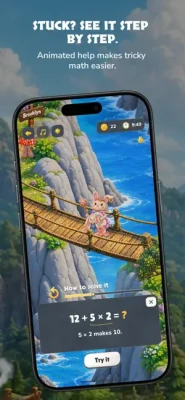
If a question proves difficult, break it into smaller steps and work through each part together.
After completing a session, review the My Scores section and discuss the types of questions that were easiest or most challenging.
Short, consistent practice sessions are often more useful than long periods of repetitive activity.
Most importantly, allow children to enjoy the adventure. Positive encouragement can make mathematical learning feel rewarding rather than stressful.
Tips and Tricks for Better Results
Start with a comfortable difficulty. Choosing a suitable level helps prevent frustration and encourages steady improvement.
Understand the question before answering. Reading the numbers carefully reduces unnecessary mistakes.
Practice multiplication regularly. Familiarity with multiplication tables makes Hard and Expert challenges easier.
Use addition to understand subtraction. The connection between these operations provides a helpful way to check answers.
Learn multiplication and division together. Recognizing how these operations relate makes Expert questions more manageable.
Take advantage of unlimited thinking time. There is no need to rush through a question when careful reasoning can produce a better result.
Focus on accuracy before speed. Faster answers and additional rewards will come naturally as mathematical confidence improves.
Review previous scores. Personal records help children recognize their progress and identify areas that need more practice.
Explore the character interactions. The characters and their animations make the learning experience more engaging.
Enjoy the complete story. Remember that the goal is not simply to complete calculations but to help Bella and Pan bring the missing toys home.
Offline Gameplay and Family-Friendly Features
One of the strongest advantages of Bella and Pan is its offline functionality.
The complete adventure can be played without an active internet connection. This makes it suitable for family trips, flights, and situations where Wi-Fi is unavailable.
The game also does not require children to create an account before playing.
There are no advertisements interrupting the adventure and no in-app purchases in the listed version. Progress and scores remain stored locally on the device.
Parents can also control music and sound effects, while external links and support information are protected by parent-gated access.
These features help create a more focused experience in which children can concentrate on mathematics and storytelling.
Graphics, Music, and Gameplay Experience
Bella and Pan uses a handmade visual style built around imaginative characters, colorful environments, and animated interactions.
Its world is designed to feel welcoming rather than competitive. The characters provide personality, while the different environments help maintain interest throughout the three chapters.
Music and sound effects contribute to the atmosphere and make character interactions feel more lively.
The game also supports portrait and landscape orientations on compatible iPhone and iPad devices, allowing families to choose a comfortable way to play.
The combination of visual storytelling, interactive mathematical questions, and character animations gives Bella and Pan an identity that is different from traditional educational quiz games.
Is Bella and Pan Worth Playing?
Bella and Pan is an appealing option for parents searching for an educational game that makes mathematics more enjoyable for young children.
Its biggest strength is the way it connects arithmetic practice with a continuous adventure. Addition, subtraction, multiplication, and division are not presented as disconnected exercises. Instead, they become part of a journey involving friendly characters, interesting locations, and meaningful objectives.
The four difficulty levels also provide flexibility for children with different mathematical abilities. Beginners can develop their confidence with addition, while more experienced learners can explore multiplication, division, and combined operations.
Its offline functionality, lack of advertising, absence of in-app purchases, and locally stored progress are additional advantages for families.
Children who enjoy colorful adventures and interactive learning activities may particularly appreciate its approach.
Overall, Bella and Pan offers a thoughtful combination of education, storytelling, and entertainment. It encourages children to practice essential mathematical skills while helping two lovable explorers complete an imaginative journey.
Frequently Asked Questions
What is Bella and Pan?
Bella and Pan is an educational adventure game in which children solve mathematical questions to help two explorers complete a journey and recover missing toys.
What age group is Bella and Pan designed for?
The current expanded game listing describes mathematical challenges suitable for children from Kindergarten through fifth grade. The best difficulty depends on each child's individual skills and confidence.
Can players choose between Bella and Pan?
Yes. Players can select Bella or Pan as their main explorer before beginning the adventure.
How many chapters are included?
The game includes three connected chapters featuring Willow Valley, Saltwind Coast, and Goldtide Sea.
What mathematical subjects are included?
The game covers addition, subtraction, multiplication, division, parentheses, and combined mathematical operations, depending on the selected difficulty.
Does Bella and Pan have different difficulty levels?
Yes. The game offers Easy, Medium, Hard, and Expert difficulties.
Can children play Bella and Pan offline?
Yes. The complete adventure works without an internet connection.
Does the game contain advertisements?
No. Bella and Pan is designed without advertisements.
Are there in-app purchases?
The listed version includes the complete adventure without in-app purchases.
Can children save their scores?
Yes. Game progress and scores are stored locally on the device, allowing players to review their previous results and personal bests.
Does the game have a time limit for answering questions?
No. Children can take their time to think through mathematical problems without a strict answer deadline.
Is Bella and Pan available on iPhone and iPad?
Yes. The game supports compatible iPhone and iPad devices and offers both portrait and landscape gameplay.
Who developed Bella and Pan?
Bella and Pan was developed by BKRXY LLC as a father-and-daughter project. Brooklyn contributed the original character drawings and stories, while her father worked on building the game.
Final Thoughts
Bella and Pan demonstrates how educational games can turn ordinary learning activities into memorable experiences. Through its imaginative story, lovable characters, and carefully structured mathematical challenges, it gives children an enjoyable reason to practice their arithmetic skills.
Whether a child is learning addition for the first time or becoming more confident with multiplication and division, the different difficulty settings provide opportunities to develop at a comfortable pace.
With three connected chapters, offline gameplay, rewarding character interactions, and a family-friendly design, Bella and Pan is a delightful mathematical adventure for children and their families.
Rate the Game
User Reviews














Popular Games


















 Android
 iOS
 Windows
 Xbox